
Fresh off the pasting line, a battery plate cannot store a single ampere-hour. It is a grid of lead alloy carrying a dried, cured paste — a family of basic lead sulphates and lead oxides, chemically closer to a mineral than to a machine. Between that inert grey biscuit and the living electrode of a working cell stands one factory process the datasheets barely mention and the buyer never sees: formation. It is the first charge of the battery’s life, performed with more care than any charge it will ever receive again, and it decides — permanently — how much of the lead-acid battery’s promise a given plate will keep. Here is what actually happens, and why a buyer should care about a process they will never watch.
What the current actually does
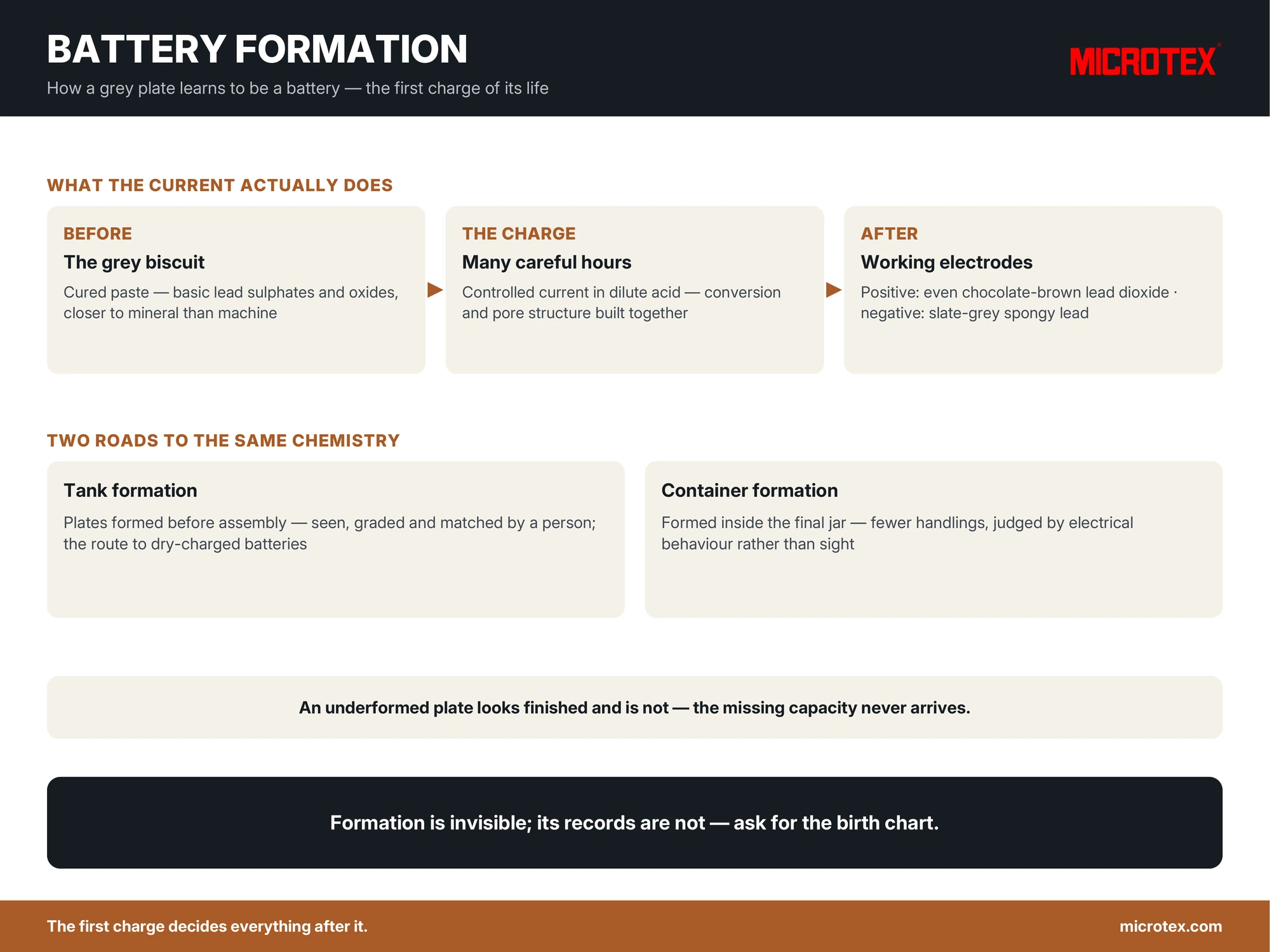
Formation is electrochemistry running its very first shift. The plates are immersed in dilute sulphuric acid and a controlled charging current is passed for many hours, converting the cured paste into the two working materials our electrochemistry guide derives: the positive plate’s paste becomes lead dioxide, the negative’s becomes spongy metallic lead. The transformation is visible — the trade’s oldest inspection instrument is the eye. A properly formed positive turns a deep chocolate brown, even and unblotched; a properly formed negative settles into a soft slate grey with a faint metallic sheen. What the eye cannot see matters more: the conversion must run deep into the paste, not merely across its face, and it must build the porous internal architecture — acid must reach the interior of the plate for the rest of the battery’s life through the pore structure formation leaves behind. An underformed plate looks finished and is not: unconverted material contributes nothing, and capacity the nameplate promises simply is not there. This is also why formation is deliberately unhurried: the conversion and the architecture are built together, and a schedule that forces the chemistry faster than it wants to run leaves its signature in the plate for good.
Tank or container: two roads to the same chemistry
The trade runs formation by two routes. In tank formation, plates are formed in open tanks of acid before assembly: racks of plates, formed together, then washed, dried and built into cells. Its virtues are uniformity and inspection — every plate can be seen, graded and matched before it is committed to a cell — and it is the route that yields the dry-charged batteries our filling guide teaches you to wake correctly. In container (or jar) formation, the plates are assembled first and formed inside the battery’s own container, saving handling and washing at the cost of forming blind — the plates are judged by electrical behaviour rather than sight. Both routes are legitimate; serious factories choose per product and say so without embarrassment. What is not legitimate is hurrying either one. Formation time is production capacity, and the commercial temptation to shorten it is permanent — which is precisely why the process discipline of the factory you buy from is a purchasing criterion, not a curiosity.
Why the buyer should care about an invisible process
Formation quality cannot be inspected at delivery. A well-formed and a poorly-formed battery look identical on the dock; the difference surfaces as the capacity that arrives — or doesn’t — across the first cycles of service. This is the engineering reality behind a contractual detail our battery standards guide explains: the standards’ first-discharge allowance, which permits a battery to deliver somewhat under its rated capacity on its very first test and grow into the full figure across early cycles. A battery that starts inside the allowance and climbs is behaving; one that starts low and stays low is very often telling you a formation story — and the acceptance discharge test is where that story gets told under oath. The practical consequence for a buyer is simple: formation is invisible, but its records are not. A factory that controls formation keeps charge logs, per-batch records and inspection results — a birth chart for every battery it ships. On the tank route it keeps something else besides: formed positives that were seen, graded and matched by a person before assembly — ask whether that inspection happens, and who signs for it.
Our own cards on the table
We make our plates and run our own formation in-house, on dedicated formation rectifiers, with the logs to show for it — it is half the reason we can write this article without flinching. When a customer’s acceptance test raises a question, the first place our engineers look is the battery’s own birth record, and more than once that record has ended an argument before it began. If you are specifying batteries for duty that matters, add one line to your enquiry: ask how the plates are formed, and ask what records travel with the batch. The factories with good answers will enjoy the question. If you’d like to put it to us first, our engineers are easy to reach — and unusually willing to talk about grey biscuits.