
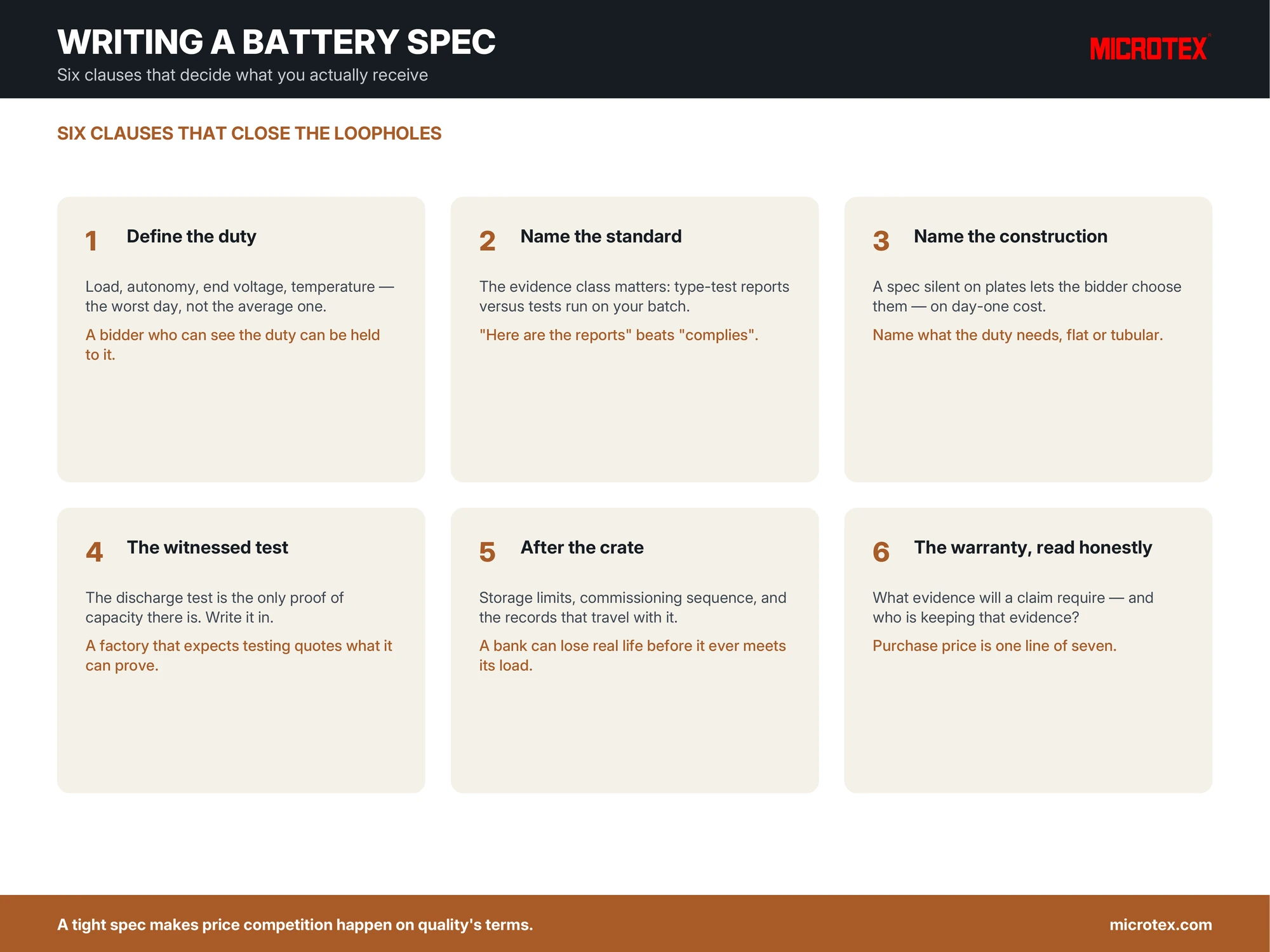
Most battery specifications are two lines long — a voltage and an ampere-hour figure — and two lines is exactly enough rope for the cheapest bidder to hang you with. A specification is not paperwork; it is the only instrument a buyer has for making price competition happen on quality’s terms. Write a loose one and every bidder is silently invited to interpret it downward, because the one who interprets it furthest down quotes the lowest number and wins. Write a tight one and the game reverses: bids become comparable, corners become visible, and the cheap quotation has to explain itself. We answer tenders for a living, so read this with that bias declared — but notice that a tight specification is not written in the seller’s favour. It is written in the duty’s favour. Six clauses do most of the work.
Clause one: specify the duty, not just the battery
An ampere-hour figure without conditions is an answer without a question. The honest starting point is the duty itself: what load, for how long, to what end voltage, at what temperature, cycling or standby, and what happens on the worst day rather than the average one. That is precisely the five-step chain our battery sizing guide walks through, and the spec should show its working — because a bidder who can see the duty can be held to it. State the duty and ask bidders to demonstrate their offered battery meets it; a supplier who sizes honestly will show calculations, and a supplier who will not show calculations has told you something more useful than any brochure. This clause also future-proofs the file: when the bank is questioned years later, the duty it was bought for is on record.
Clause two: name the standard — and the class of evidence
Standards exist so that buyers do not have to trust adjectives, but a bare standard number on a datasheet proves less than most buyers assume — our battery standards guide decodes what the common Indian and international standards actually fix. The spec should therefore do two things: name the standard the battery must meet, and name the evidence class for each requirement — which claims must be backed by type-test reports, and which will be demonstrated on your batch by routine acceptance tests. Ask for the type-test evidence with the bid, not after the award. The difference between “complies with the standard” and “here are the reports” is the difference between a sentence and a fact.
Clause three: name the construction the duty needs
Two batteries with identical nameplates can carry entirely different machinery inside, and the single most consequential line you can add to a spec is the plate construction. Deep daily cycling, long calendar life and abuse tolerance argue for tubular plates; some duties are honestly and economically served by flat plates — the trade-offs are laid out in our flat plate versus tubular guide. The point is not that one construction is universally right; the point is that a spec which is silent on construction invites the bidder to choose it for you, and the bidder’s incentive is day-one cost, not year-eight capacity. Name the construction, or require bidders to declare and justify theirs against the duty in clause one. Silence here is the single most expensive omission in battery buying.
Clause four: the acceptance test — the clause that disciplines every other clause
Everything before this line is promises. The acceptance clause is where promises meet an ammeter. Specify a witnessed capacity discharge test — who witnesses, at what conditions per the named standard, what counts as a pass, and what happens on a fail — because, as our battery testing guide is blunt about, the discharge test is the only proof of capacity there is. This clause costs almost nothing to write and changes bidder behaviour all by itself: a factory that expects to be tested quotes what it can prove. We welcome witnessed acceptance tests on our own batteries and have said so in print; ask every bidder to accept the same sentence and watch the field sort itself.
Clauses five and six: after the crate, and the warranty read honestly
Clause five covers the gap most specs forget: between despatch and duty. Require the supplier to state the storage limits before first charge, the commissioning sequence, the records that travel with the batch, and the support provided at first charge — the full sequence our battery commissioning guide lays out. A bank can lose real life in this gap before it ever meets its load, and a spec that is silent about it will own that loss. Clause six is the warranty, read as an engineer: what duty does it assume, what evidence does a claim require, and does the supplier’s own commissioning and maintenance documentation help you create that evidence or quietly ensure you will never have it? Fold the whole thing into lifetime arithmetic — our total cost of ownership guide gives the ledger — and the two-line spec’s false economy becomes visible on paper before it becomes visible in a dark substation.
The six lines, and an open offer
Six clauses, then: the duty defined; the standard named with its evidence class; the construction named; the witnessed acceptance test; commissioning and records; the warranty’s evidence contract. None of them requires a single number this article could supply — every number belongs to your duty, which is the entire point. If you are drafting a specification for a substation, telecom, solar or traction duty, send our engineers the draft — we read battery specifications for a living, we will tell you where a bidder could slip through yours, and the advice does not oblige you to buy a single cell from us. And if you want the evaluation lens for the factories that respond, our guide to choosing a battery manufacturer is the companion piece to this one.