
A forklift battery is not one thing that fails; it is twenty-four things in a steel box, and usually only one of them has. That is the whole economics of traction battery service in a sentence, and Linden’s handbook makes the same point: because a deep-cycling traction battery is assembled from separate cells, a failure confined to one or two of them can be dealt with economically by repairing or replacing just those cells. A sealed car battery with a dead cell is scrap. A traction battery with a dead cell is a repair job — if the rest of the battery is worth repairing, which is the question this guide is really about. It sets out what a proper service visit should contain, which faults are fixable and how, which ones mean the battery is finished, and how to tell the two apart before money is spent.
A service visit is a diagnosis first
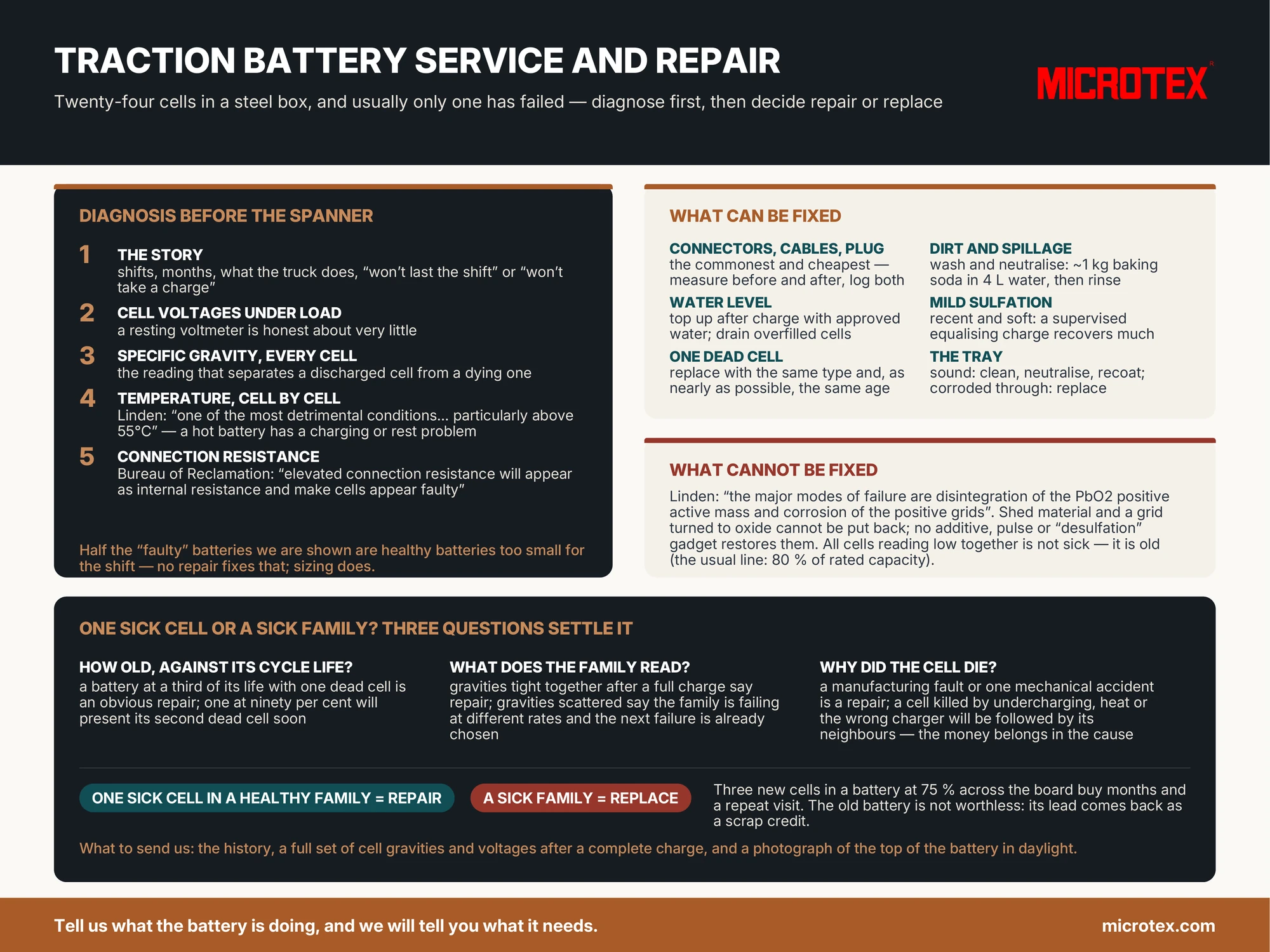
The worst service is the one that starts with a spanner. A traction battery arrives with a story — how many shifts, how many months, what the truck does, whether it fails to last the shift or refuses to take a charge — and the story narrows the verdict before anything is opened, exactly as our guide to battery failure analysis insists. Then the instruments, in order. Cell voltages under a real load, because a resting voltmeter is honest about very little. Specific gravity in every cell, not a sample — the flooded battery’s privilege, and the one reading that separates a discharged cell from a dying one, as our specific-gravity guide explains. Temperature, cell by cell; Linden calls high temperature “one of the most detrimental conditions for a battery, particularly above 55°C”, and a battery that comes off the truck hot has a charging or rest problem, not a cell problem. Connection resistance across every intercell link and the truck plug, because the US Bureau of Reclamation’s manual warns that “elevated connection resistance will appear as internal resistance and make cells appear faulty” — a corroded strap will get a healthy cell condemned. Only then the tray, the cables, the vent plugs and the electrolyte level. Linden adds the oldest diagnostic of all: the drop in electrolyte specific gravity over a working day is a rough gauge of whether the battery suits its job, and where the truck cannot finish its work he prescribes a bigger battery, or repair or replacement. Half the supposedly faulty batteries we are shown are healthy batteries that are too small for the shift, and no repair fixes that; our battery sizing guide does.
What can be fixed, and how
Connectors, cables and the plug. The most common repair, and the cheapest. Intercell connectors that have corroded, cables whose insulation has been eaten by acid mist, truck plugs with burnt contacts from being pulled under load — all replaceable, all restoring capacity that was never actually lost. Our guide to terminal corrosion gives the micro-ohm doctrine and the cleaning drill; the service rule is measure before and after, and log both. Dirt, spillage and stray current. Linden’s maintenance section puts cleanliness first: a clean battery top keeps corrosion off post connectors and steel tray and saves costly repairs, and dirt must be cleared before damp turns it into a path for stray current. A wet, dirty battery top leaks current between cells and to the tray — the earth-fault symptom our guide to DC earth faults describes — and it is fixed with a wash, not a cell. Spilt acid does not dry off by itself; Linden’s recipe is to neutralise it with a baking-soda solution of “approximately 1 kg of baking soda to 4 L of water”, followed by a thorough rinse. Electrolyte level and water. Low cells are topped after charge with approved water, as our battery water guide sets out; overfilled cells are drained back, because Linden warns that acid overflowing the cells corrodes the tray, opens earth paths and costs cell capacity. Mild sulfation. A battery that has been left part-charged, or opportunity-charged to nowhere, sulfates; if it is recent and soft, a properly supervised equalising charge recovers much of it — the only so-called reconditioning with physics behind it, and our guide to battery sulfation is honest about where it stops. The single dead cell. A cell that has shorted, opened or lost its active material while its neighbours read healthy is cut out and replaced with a cell of the same type and, as nearly as possible, the same age — a new cell in an old string is pulled to the old string’s level within months. The tray. Steel trays corrode where acid has pooled; a sound tray is cleaned, neutralised and recoated; a tray corroded through is replaced, because a battery sitting in a conductive puddle is an earth fault waiting for a shift.
What cannot be fixed
Linden names the two ways a traction battery dies of age: “the major modes of failure are disintegration of the PbO2 positive active mass and corrosion of the positive grids”, adding that at end of life the positive plate usually sets the capacity. Shed active material lies as sediment at the bottom of the cell; a corroded grid has become a poor conductor wrapped in its own oxide. Neither can be put back. No additive, pulse or desulfation gadget restores a positive plate that has physically gone — our guide to battery myths gives that trade its verdict — and a battery whose cells are all reading low gravity and low capacity together is not sick, it is old. The decision rule is the one our failure-analysis method publishes: one sick cell in a healthy family is a repair; a sick family is a replacement. Linden’s convention for when a battery is finished is that it “will no longer produce 60 to 80% of its initial or rated discharge capacity”, and the industry’s usual line is the top of that band — the 80 % our guide to how batteries die explains. Replacing three cells in a battery that is at 75 % across the board buys a few months and a repeat visit; the honest service engineer says so, and quotes for the new battery instead.
The repair-or-replace arithmetic
Three questions settle it. First, how old is the battery against its expected cycle life in this duty — a battery at a third of its life with one dead cell is an obvious repair; one at ninety percent with one dead cell is a battery that will present its second dead cell soon. Second, what does the rest of the family read — gravities tight together after a full charge say repair; gravities scattered say the family is failing at different rates and the next failure is already chosen. Third, why did the cell die — a manufacturing fault or a single mechanical accident is a repair; a cell killed by chronic undercharging, heat or a wrong charger will be followed by its neighbours, and the money belongs in the cause, which is usually the charger and the shift pattern, not the battery. Put the numbers in the ledger our guide to battery total cost of ownership lays out, and remember that the old battery is not worthless: its lead comes back as a scrap credit, the positive sign at the end of the line that our guide to the closed loop explains.
Bring us the battery
We build traction batteries on our own tubular plates, and a battery that comes back to us tells us more about our own product than any test in the factory does — so we would rather see it than hear about it. If a battery is not lasting the shift, send us the history, a full set of cell gravities and voltages after a complete charge, and a photograph of the top of the battery in daylight. From those three things we can usually say whether you have a repair, a sizing problem, a charging problem or a battery at the end of its life — before anyone opens a cell. Tell us what the battery is doing, and we will tell you what it needs.
Sources quoted: T. B. Reddy (ed.), Linden’s Handbook of Batteries, 4th ed. (McGraw-Hill, 2011); U.S. Bureau of Reclamation, FIST Volume 3-6: Storage Battery Maintenance and Principles (April 2020).