
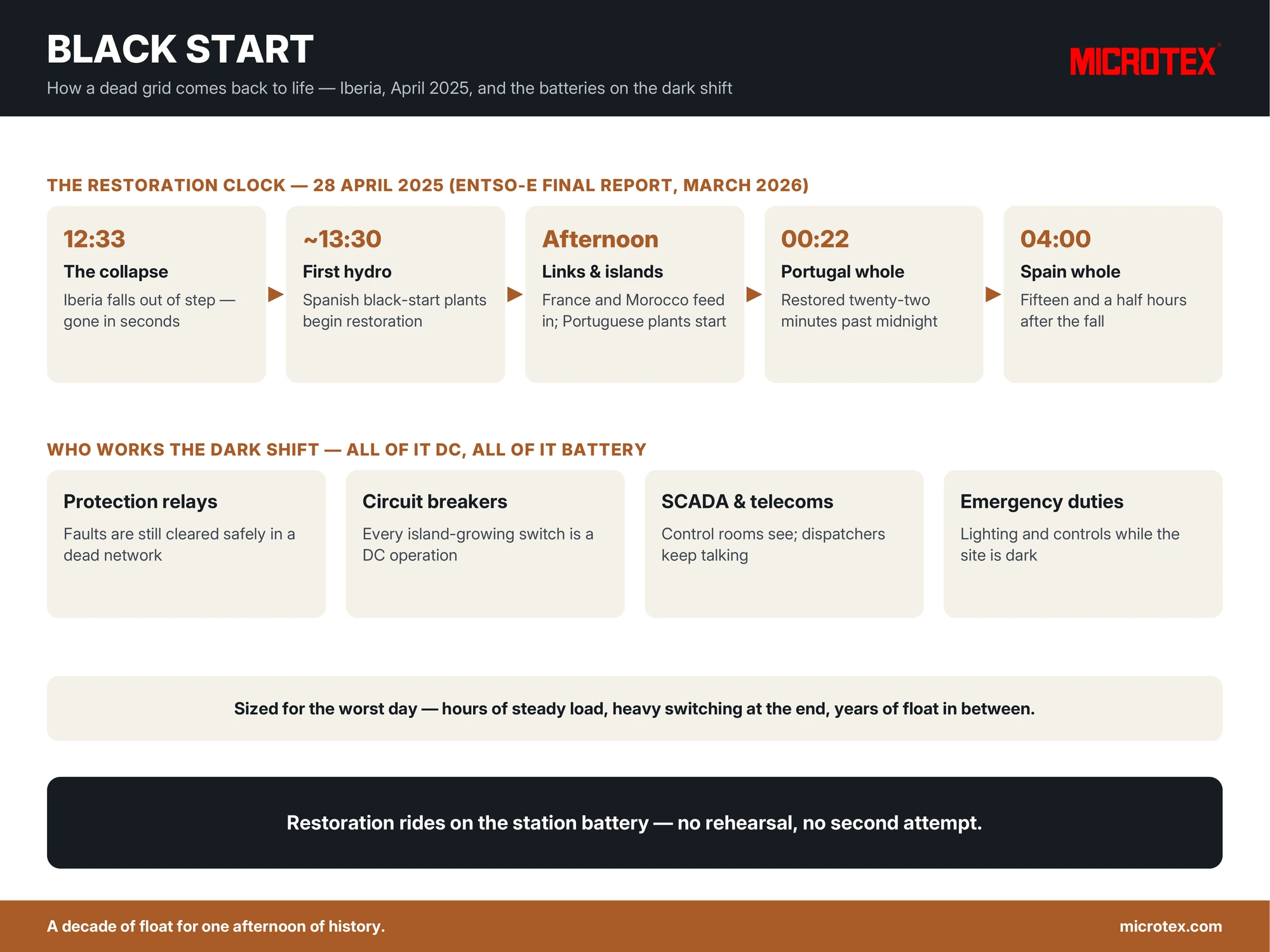
At 12:33 on 28 April 2025, the Iberian Peninsula lost its electricity in seconds. By ENTSO-E’s account, the peninsula fell out of step with the European grid at 12:33:19; five seconds later the Spanish and Portuguese systems had collapsed. The year of argument that followed — settled, factually at least, by the expert panel’s final report of March 2026, which found a combination of factors including oscillations and gaps in voltage and reactive-power control — has mostly been about why the grid fell. This article is about the other half of the story, the half a battery maker knows something about: how a dead grid stands back up, and what keeps working through the hours when nothing else does. The details below carry their dates — as of 2026 — and this page will be refreshed as the field moves.
The cold-start problem
Here is the uncomfortable circularity at the heart of every blackout: power stations need electricity before they can make electricity. Pumps, fans, lubrication, control systems, the excitation that builds a generator’s magnetic field — all of it draws power, and with the grid dead there is nowhere to draw it from. Most large plants simply cannot start themselves. The way out is a small set of designated units that can — black-start units, in the trade’s old phrase — and the classic among them is hydro: open the gates, let water spin the machine, and electricity exists again. From that seed, operators energise a corridor of lines, wake neighbouring plants, grow an electrical island, and then perform the most delicate manoeuvre in power engineering: stitching islands together in exact synchronism. That is precisely how the peninsula came back. ENTSO-E’s report records re-energisation arriving from France and Morocco while black-start hydro plants restarted the system from within — Spain’s beginning around 13:30, two Portuguese plants following in the late afternoon. Portugal was whole again by 00:22; Spain by 04:00 the next morning, some fifteen and a half hours after the collapse.
The dark shift: what runs while nothing runs
Now look inside a substation during those fifteen hours. The busbars are dead, yet the building is not: protection relays stay lit, circuit breakers stand ready to trip and close on command, SCADA keeps reporting to control rooms, operational telecoms keep the dispatchers talking. None of that runs on the grid — it runs on the station’s DC system, fed by a battery bank that has spent years doing nothing anyone noticed. Restoration is not merely helped by these banks; it is carried by them. Every breaker operation that grows an island is a DC operation, and an exhausted station battery does not just inconvenience a substation — it takes that node out of the restoration plan. This is the quiet argument of our substation battery page, and it scales with consequence: a nuclear plant’s version of the dark shift is severe enough that we gave it its own article, and the telecom towers that kept phones alive through the Iberian afternoon were riding out the same hours on their own DC. A battery bank asked to work the dark shift is sized for it deliberately — hours of steady load with heavy switching duty at the end, which is exactly the discipline our battery sizing guide teaches — and it spends the years between blackouts in the quiet custody of float charging: a decade of readiness for one afternoon of history.
Batteries that light the match
The newer chapter is batteries not merely surviving the blackout but starting the recovery. The proof-of-principle is nearly a decade old: in 2017, a public utility in southern California used a 33-megawatt battery installation to start a 44-megawatt gas turbine from dead — reported across the trade press at the time as a first-of-its-kind demonstration. What was a demonstration then is procurement now. In Great Britain, the system operator NESO has retired the very phrase “black start”: the service is formally the Electricity System Restoration Service, and NESO’s Distributed ReStart research programme — run with a distribution network operator and a specialist consultancy — spent three years establishing that restoration can also be built bottom-up, from distributed resources, rather than only top-down from big plants. As of 2026, NESO restoration tenders are running with service start dates of December 2026 and December 2028, open to technologies our BESS guide describes. The engineering catch is worth one honest sentence: a restoration battery must hold its state of charge until the worst day and then sustain output for as long as the plan needs — which is the duration question our long-duration storage article examines, wearing a different hat.
Where we honestly sit
We should be plain about our own seat in this story. Microtex does not build grid-scale BESS, and the batteries lighting the match in California and Britain are not ours — we have said elsewhere, honestly, that grid-scale storage has gone to lithium. Our trade is the other role, the one every restoration plan silently assumes: the station bank that is already there, already charged, and already carrying the DC load when the lights go out — in substations, generating stations, control centres and networks that must switch, protect and communicate through the dark shift. That bank earns its keep perhaps once in a decade, with no rehearsal and no second attempt, which is why it is specified, sized and maintained with a conservatism outsiders mistake for old-fashionedness. If your substation, plant or network carries a DC bank whose blackout duty you can describe — the load, the hours, the switching at the end — put it to our engineers. The answer will come back in duty cycles and ampere-hours, and it will assume the grid is not there to help.