
An equalising charge is a deliberate, controlled overcharge — and most of the chargers in the world are built, quite intentionally, so that they cannot give one. That single sentence resolves most of the confusion around equalisation equipment. People read that their flooded battery needs a periodic equalising charge, walk to the charger that has served them faithfully for years, and find no button for it. Nothing is broken. A modern charger’s whole design promise is to stop before the battery gasses; an equalising charge works by going, carefully and briefly, beyond that point. So the machine that protects your battery every night is the wrong machine for the one job that requires trespass. This guide is about the right machine: what equalisation capability actually looks like, where it is found, and what to ask before you buy it — because the searches that bring people here show they are being sold “equalisation chargers” with no explanation of what the words mean.
Why your everyday charger refuses
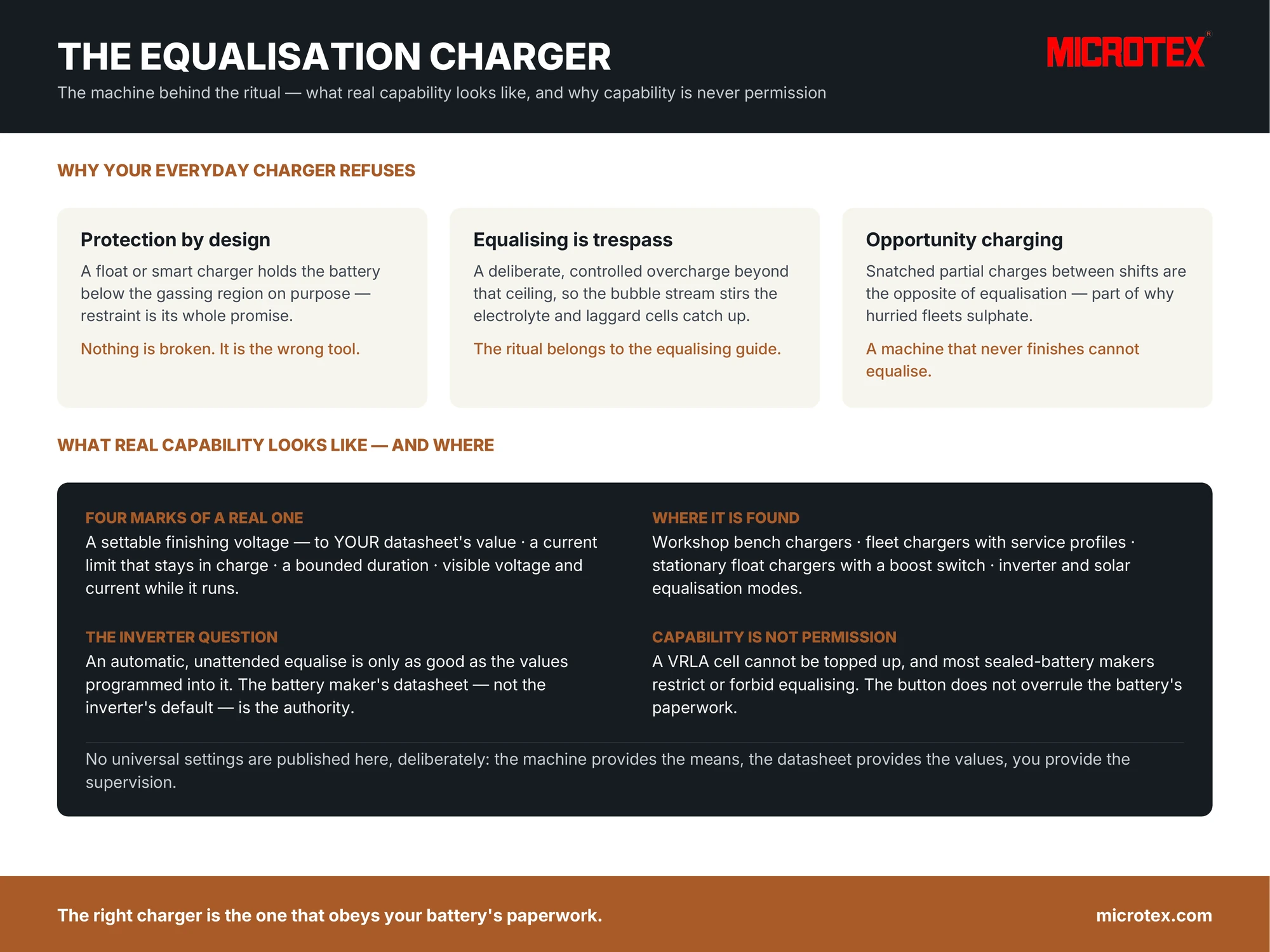
A float or smart charger holds the battery at a finishing level chosen to keep gassing and water loss to a minimum — that restraint is a feature, engineered in on purpose, as our guide to battery chargers explains. Equalisation lives on the other side of that ceiling: the cell is pushed into the gassing region on purpose, so the rising bubbles stir the electrolyte back to uniformity and the laggard cells catch up — the mechanism belongs to acid stratification and the ritual to the equalising charge guide, and neither is repeated here. The point for equipment selection is simply this: a charger with no way to raise its finishing level under control cannot equalise, however premium its brochure. And opportunity charging — snatched partial charges between shifts — is the opposite end of the earth from equalisation, which is part of why hurried fleets sulphate, as our charging efficiency guide sets out.
What “equalisation capability” actually is
It is a supervised mode, not a magic box. Stripped of marketing, a charger that can equalise offers four things. A way to raise the finishing voltage above its normal level — by a controlled amount, to the value your battery’s maker specifies, not to whatever the knob allows. A current limit that stays in charge of events while the voltage is raised. A bounded duration — a timer, a cut-off, or an operator who ends the run when the measurements say so, never “until someone remembers”. And visibility: some indication of voltage and current while it runs, because an equalising charge is judged by readings, not by faith. The numbers themselves — target voltage, duration, frequency — belong to your battery’s datasheet and to the equalising guide’s discipline; no honest page can publish universal settings, and this one will not. What the machine must provide is the means; what the datasheet provides is the values; what you provide is the supervision.
Where the capability is found
Four places, in descending order of ceremony. Workshop and service chargers — the adjustable bench machines battery shops live by — are the classic home: manual control, current limiting, and an operator standing there, which is the whole point. Fleet and traction chargers increasingly carry a service or weekly profile that performs a scheduled equalise on flooded cells; the capability is real, but confirm it is enabled, configured to your battery’s values, and actually reaching completion — a profile nobody commissioned is a checkbox, not a maintenance programme. Stationary float chargers in substations and plant DC systems often carry a boost or equalise switch for exactly this duty, used under permit and supervision on the schedules the site’s engineering sets. And inverters and solar charge controllers — the source of the “battery equalization in inverter” question the search data keeps asking — frequently include an equalisation mode for flooded tubular batteries: legitimate in principle, but treat an automatic, unattended equalise with respect. The mode is only as good as the values programmed into it and the watering routine around it, and the battery maker’s datasheet — not the inverter’s default — is the authority. If the two disagree, the battery loses either way; make them agree first.
Capability is not permission
One honesty section, before the checklist. The equalising charge described here is a flooded-battery ritual. For sealed batteries the story inverts: a VRLA cell cannot be topped up, so the water an equalise boils off is gone for good, and most sealed-battery makers restrict equalising sharply or forbid it outright — the reasoning is in our VRLA maintenance guide. A charger with an equalise button does not overrule the datasheet of the battery connected to it. The same logic runs everywhere: capability in the machine is never permission from the battery. Permission lives in one document, and it was written by whoever will judge your warranty claim — a point our battery myths post makes with some feeling.
Six questions before you buy one
Ask these of any charger being sold to you with the word “equalisation” attached. Can the finishing voltage be set to my battery’s datasheet value — not just “higher”? Is the current limited, and adjustable, while it does so? Is the duration bounded — timer, cut-off or supervised stop — and what ends the run? Does it show me voltage and current while it works? Does it compensate for temperature, and how? And what does the battery’s maker say about this charger’s profile — have the two documents ever been introduced to each other? A vendor who answers all six plainly is selling you a tool. A vendor who answers with the brochure is selling you a word.
The machine is the smaller half
Here is the conclusion the equipment catalogues will not print: the charger is the smaller half of equalisation. The larger half is the discipline around it — knowing the bank needed the charge at all, which is a specific gravity log speaking; running it on the battery maker’s values; watering afterwards; and measuring at the end, because an equalise that nobody verified is a rumour, not a maintenance act. The reading habit belongs to the maintenance walk-round, the cure it prevents to the sulfation guide. If you are choosing a charger for a flooded bank — traction, stationary or solar — tell us the battery model and the duty, and we will tell you what the machine must be able to do for that battery, in ampere and volt terms you can put in a purchase order. The right charger is not the one with the most buttons; it is the one that can be made to obey your battery’s paperwork.