
🌎 Español · 🇷🇺 Русский · Français · Português
/ RESERVE POWER · TUBULAR GEL (VRLA) · 2 V CELLS
OPzV battery — tubular gel 2 V cells, 200 to 3000 Ah, for places nobody visits
Specified, CPRI type-tested and delivered in 60 days: Microtex builds OPzV cells in Bengaluru for solar fields, telecom towers, oil-and-gas outstations and every site where no one tops up a battery and the afternoon is hot. Inside is the same long-life tubular plate as our flooded OPzS, sealed into a gel electrolyte that asks for no watering, and the datasheet, the sizing and the test evidence go out with the offer. Gel batteries have been made here since 2007, sold as our Eternia gel range.
/ DOCUMENTS · PDF
Datasheets for a single type, test reports and tender documentation come with the offer — ask with your enquiry.
CPRI type-tested — 2V 1200 Ah OPzV · 2V 1000 Ah T-Gel — Gel manufacture since 2007 — Maintenance-free VRLA — 4 OPzV 200 to 24 OPzV 3000 — 60-day delivery
Specification at a glance
| Item | Microtex OPzV |
|---|---|
| Cell type | 2 V valve-regulated stationary cell with tubular positive plates and the acid immobilised in silica gel (OPzV); nothing to top up for the life of the cell |
| Ranges | Fourteen DIN-designation types in the catalogue, 4 OPzV 200 to 24 OPzV 3000 (nominal 200 to 3000 Ah; catalogue C10 ratings 238 to 3337 Ah to 1.80 V per cell, with the C8, C5, C3 and C1 ratings, internal resistance and short-circuit current (catalogue values, for fuse and protection sizing), dimensions and weights stated for every type). Further types on request — their data is under revalidation. Also built: T-Gel cells. The size tables come with the offer |
| Standards to specify | IEC 60896-21 and IEC 60896-22 (the IEC test methods and requirements for valve-regulated stationary cells), IEC 62485-2 for installation safety; cell designations as DIN 40742. Tell us which standard and which test numbers your tender calls for and the offer quotes against them |
| Type tests and reports | CPRI Bengaluru, January 2025 — 2 V 1200 Ah OPzV (12OPzV 1200: marking, rated capacity, Ah and Wh efficiency) and 2 V 1000 Ah T-Gel (2VT 1000PP), type-tested against customer specification; report numbers and ULR references quoted in the tender documentation we send with the offer |
| Design life (catalogue) | Float: 15 years or more (catalogue design value, rated at 27 °C; not a warranty). Cycle: 5200 cycles at 20 per cent depth of discharge, 3000 at 50 per cent, 1800 at 80 per cent — catalogue design values at 27 °C |
| Operating conditions (catalogue) | Operating temperature −20 °C to +45 °C, with 10 °C to 35 °C recommended and 45 °C to 55 °C for short periods only; self-discharge about 2 per cent a month at 25 °C; storage without a refresh charge up to six months, under the conditions in the instruction manual. Catalogue design data: the capacity table is rated at 25 °C; the float- and cycle-life values are design values rated at 27 °C |
| Orientation | Upright as standard; horizontal operation is possible (catalogue) — say so with the enquiry so that the rack and the connectors are designed for it |
| Vendor registrations | Registered vendor: NPCIL · BARC · ONGC · BPCL · IOCL — registration documents supplied with tender documents |
| Manufacturing | Alloys, oxide, plates, gauntlets and separators made in-house in Bengaluru; containers and lids moulded within the Microtex group |
| Delivery | 60 days from order confirmation, cells and assembled banks |
| Warranty | 12 months from the date of invoice as standard; project terms as stated in the offer |
| Documentation | Datasheet and drawing, CPRI type-test reports, installation and maintenance manual, a commissioning baseline record (cell voltages, internal resistance and temperature on day one), and a ventilation calculation for your room on request |
Where OPzV is chosen over OPzS — and where it is not
OPzV is the DIN designation for a stationary cell on tubular positive plates with the electrolyte immobilised in gel and a valve in place of the open vent — the same plate family as our OPzS battery, built to the container families tenders worldwide recognise. Choose OPzV when nobody will be on site to add water or read specific gravity; when visits are quarterly at best; when acid handling or acid fumes are not acceptable in the room; when the cells must travel and sit as non-spillable units, or lie on their side; when the duty is daily cycling from solar or hybrid generation or long autonomy for telecom and instrumentation; and when the room is unmanned but can still be kept shaded and ventilated.
Choose flooded OPzS instead when a trained maintainer will water, equalise and read specific gravity on schedule; when the longest provable life is the goal and the battery must be inspected rather than inferred; when the room runs hot and cannot be cooled, because a flooded cell carries its own heat buffer and its water can be replaced; and when the duty is heavy, short discharges, where flooded tubular and AGM designs deliver current faster. The trade is transparency against freedom from maintenance — nothing else in the electrochemistry changes.
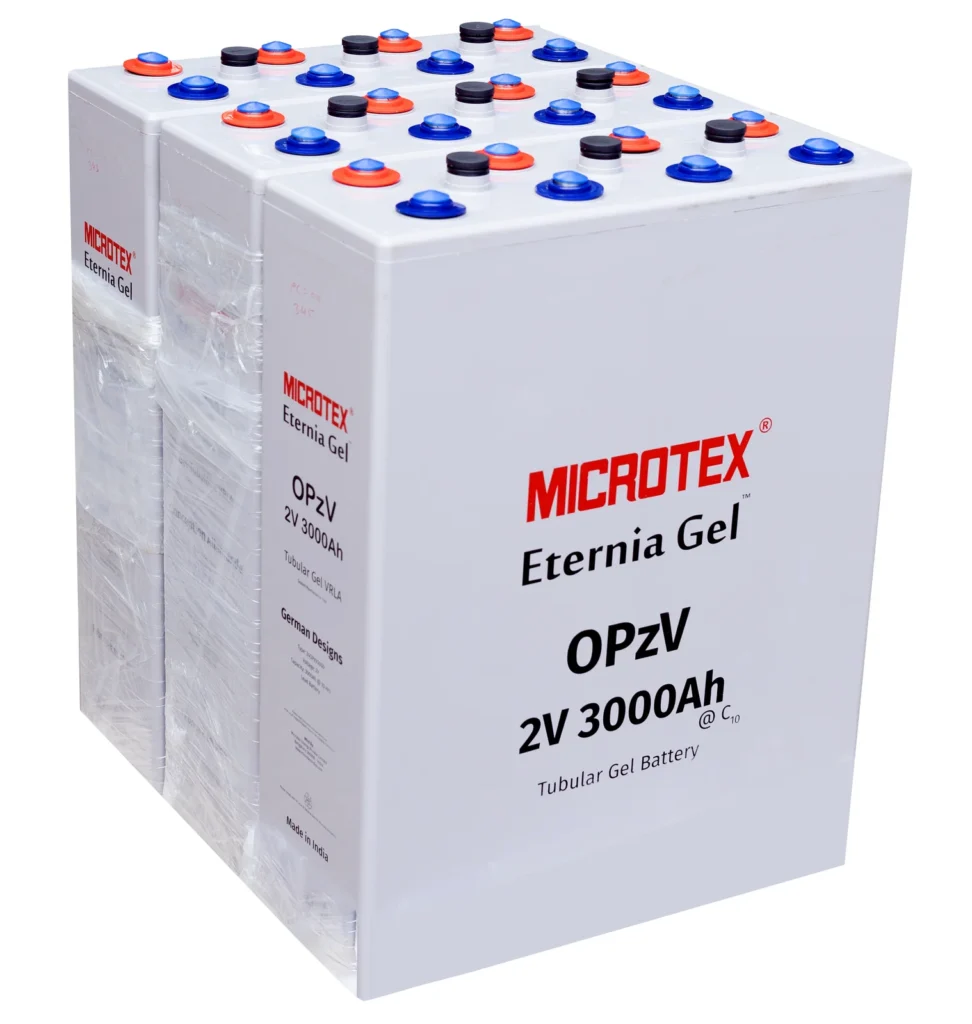
FIG. 1 — 2V OPzV TUBULAR GEL CELLS
The honest limits of gel, as the books state them
Heat. Berndt’s rule of thumb in the Battery Technology Handbook is that a 10 K rise roughly doubles the rate of an electrochemical reaction, and the gel cell is more exposed to that rule than the flooded one: Berndt shows that in a valve-regulated cell the overcharge current is turned almost entirely into heat by the oxygen cycle, and a warm cell on float draws more current, which makes more heat — the loop Berndt defines as thermal runaway when the room cannot carry the heat away as fast as the cell makes it. Pavlov puts the ceiling for normal operation of any lead-acid battery at 60 °C. So shade, airflow and temperature-compensated charging are conditions of use for OPzV, not options.
Charging precision. Bullock and Salkind, in Linden’s Handbook of Batteries, list thermal runaway under incorrect charging and a greater sensitivity to high temperature than conventional cells among the valve-regulated battery’s disadvantages; the US Bureau of Reclamation’s maintenance manual requires a VRLA charger to filter AC ripple and to compensate for temperature, and says plainly that a charger built for flooded cells is not to be used. What you cannot see. Dell and Rand’s Understanding Batteries sets the trade-offs side by side — no water to add, no spillage, any orientation and negligible stratification in the gel type, against careful charging, more critical thermal management, no specific-gravity reading, a deep-cycle life often below the flooded equivalent and a limited shelf life. Health is judged from voltage, ohmic trend and periodic capacity tests. Life in heat. Searles and Schiemann’s Battcon 2014 paper reproduces one manufacturer’s accelerated float test at 62.8 °C, converted by the Arrhenius method, which credits the flooded OPzS design with a longer equivalent life than the gel OPzV at every reference temperature from 20 °C to 35 °C. Our view follows the evidence: where a maintainer exists, OPzS gives the longer provable life, especially in a hot room; where the maintainer does not exist, OPzV is the battery that survives neglect.
Where OPzV earns its keep
Solar & hybrid power
Daily cycling, remote sites, no maintenance crew — the classic OPzV duty, in cells and assembled 48 V banks, sized on daily watt-hours, days of autonomy and the depth of discharge you will allow. The knowledge post covers what off-grid duty asks of a battery.
Telecom & instrumentation
Towers and outstations visited quarterly at best — sealed cells that hold their charge and their silence, as cells or 48 V banks.
Oil & gas outstations
Pipeline and wellhead backup in hard climates, where a maintenance visit costs more than the battery.
Unmanned infrastructure
Where OPzS would demand a watering round, OPzV holds the fort — the trade explained on the OPzS page.
From our customer’s letter — Djibouti, 2024
For TEC International of Paris, Microtex supplied, installed and commissioned sixteen sets of 48 V 3000 Ah tubular gel batteries, including standby banks, for a 288 kWh installation in Djibouti in 2024. TEC reports the systems performing satisfactorily and operating reliably under site conditions, and notes the product quality, timely execution and technical support through supply and commissioning. Published with TEC International’s permission.
Facts as written in the customer’s letter on our file. Further references on request — ask with your enquiry, or write to info@microtex.com.
Further reading
Also useful: AGM or gel — which sealed battery fits your duty, tubular gel against flooded tubular, writing a battery specification and how the tubular plate is made.
What we need for a quotation
Send whatever you have of the list below; the first reply comes within the working day and the offer carries the datasheet, the sizing with the factors used, and the evidence.
- The duty — loads and times for standby service, or daily watt-hours and days of autonomy for solar.
- Bus voltage and the lowest voltage the equipment accepts, or the number of cells.
- Capacity in Ah at C10 (or C100 for solar), or the load profile and we size it.
- Site temperature — the normal range and the worst case, and whether the room is shaded, ventilated or cooled.
- The charging source — rectifier rating, or solar array size and controller — and how often the site is visited.
- Standards and tests required — the standard the tender names and the test numbers it wants evidence for, rack type, any seismic requirement.
- Quantity, destination and delivery — number of cells or banks, the site, the date you need them on site.
- Tender reference and the due date, with the technical annexures attached.
Why gel — the honest version
In a gel cell the electrolyte is immobilised in silica gel. Two consequences do the selling. First, stratification — the slow layering of acid that quietly kills tall flooded cells between equalise charges — cannot happen; the acid cannot move. Second, the gel’s water loss is self-limiting by design: early in life the gel shrinks and forms fine cracks that become permanent oxygen channels, the recombination cycle takes over, and water loss effectively stops. That is the science behind “no topping up” — a mechanism, not a slogan (it is described in the standard reference, Pavlov, Lead-Acid Batteries, 2011).
The honesty that keeps the promise: heat is still the enemy. Every lead-acid chemistry ages faster when hot — which is exactly why the low-maintenance battery matters most in hot, remote places: nobody is there to compensate for neglect. Shade the battery room, and the gel does the rest.
Construction
The positive plate is a row of cast spines, each inside a woven gauntlet packed with active material — Microtex’s own gauntlet — so the plate cannot shed what it is made of; the negative is a pasted flat plate. The acid is set into a gel with fumed silica, a conventional separator stays between the plates, and a one-way valve replaces the vent plug. The pole seal is built to let the pillar rise with the positive plate as it grows over the years instead of stressing the lid. Every stage — the alloy, the oxide, the plates, the gauntlets and the separators — is made in our own works in Bengaluru, and the containers and lids are moulded within the group, which is why we can answer a tender question about any of them from the shop floor. The technology page shows how.
Charging — set to the datasheet, compensated for temperature
A gel cell lives or dies by its charger. The regime is constant current then constant voltage; the float voltage, the boost voltage and the temperature-compensation coefficient are printed on the datasheet for your cell type, and we do not print one universal number here because there is none. Temperature compensation is compulsory, not advisable: a cell on float draws whatever current its voltage produces, that current rises as the cell warms, and in a sealed cell nearly all of it becomes heat — lowering the float voltage as the cell warms keeps the float current near its reference value and breaks the loop at its first link, while raising it when the cell is cold ensures the cell still reaches full charge. The charger must also limit AC ripple, and a charger set up for flooded cells must not be connected to a gel bank (US Bureau of Reclamation, FIST 3-6). Boost charging is time-limited; equalising is whatever the datasheet programmes, never improvised. Send us the rectifier or the solar controller details with the enquiry and the settings come back with the offer.
Maintenance and service life
Never open a valve, never add water, never guess charger settings. Always: baseline every cell on commissioning day (voltage, internal resistance, temperature — the reference for ever), trend the same three readings every quarter, keep the room shaded and ventilated, torque-check and clean the connections yearly, and refresh-charge cells in storage at least every six months. Internal ohmic measurement is the sealed cell’s substitute for the hydrometer, with a limit the EPRI study of ohmic monitoring (report 1002925) states plainly: a rising internal resistance does track a loss of capacity, but a single reading cannot say why a cell is changing, so readings sort good cells from bad and only a capacity test proves the bank’s capacity. Searles and Schiemann draw the line a tender desk must keep: design life is the maker’s estimate under laboratory conditions at a reference temperature (our catalogue value is 15 years or more, rated at 27 °C), service life is what the site actually gets — temperature first, then depth and frequency of discharge, charger accuracy and ripple, installation and maintenance — and warranty is a promise against manufacturing defect for a stated period, not a prediction of life.
Evidence, not adjectives
| Product | Test | Where & when |
|---|---|---|
| 2V 1200 Ah OPzV (12OPzV 1200) | Marking, rated capacity, Ah/Wh efficiency — type-tested against customer specification | CPRI Bengaluru · Jan 2025 |
| 2V 1000 Ah T-Gel (2VT 1000PP) | Type-tested against customer specification | CPRI Bengaluru · Jan 2025 |
| Vendor registrations | Registered vendor: NPCIL · BARC · ONGC · BPCL · IOCL | Documents with the offer |
| Manufacturing | Alloys, oxide, plates, gauntlets, separators made in-house; containers and lids moulded within the group | Bengaluru, since 1969 |
Report numbers and ULR references travel with our tender documentation. The plates inside are the same in-house tubular construction — spines, gauntlets, oxide — described on the technology page.
Questions tender engineers ask us
OPzV or OPzS — which should my specification call for?
Sealed OPzV gel where the room is unmanned or visits are rare — solar, telecom, pipeline outstations, unmanned substations and signalling huts — and where acid handling is not allowed or the cells must lie on their side. Flooded OPzS where trained maintenance exists and the longest verifiable life is the goal, especially in a hot room that cannot be cooled. The electrochemistry is the same tubular family; the trade is transparency against freedom from maintenance.
What is the delivery time, and what shortens it?
OPzV cells and assembled banks are delivered in 60 days from order confirmation. The clock starts when the specification is settled, so the fastest route is to send the duty (loads and times, or daily watt-hours and autonomy for solar), the bus voltage, the site temperature, the charging source and the standard your tender names with the first enquiry. We reply within the working day.
Does an OPzV battery really never need topping up?
Correct — there is nothing to top up and no way in. The oxygen-recombination cycle restores the water that charging would otherwise consume. What it does need: a charger set to the gel voltages on the datasheet, with temperature compensation driven by a sensor at the battery, and a shaded, ventilated room. A flooded-battery charger profile will shorten its life.
Which standards do your OPzV cells follow, and can you quote against the one in my tender?
Our OPzV cells follow the DIN 40742 designations and container families — fourteen catalogue types from 4 OPzV 200 to 24 OPzV 3000; further types on request, with their data under revalidation. The 2 V 1200 Ah OPzV and the 2 V 1000 Ah T-Gel were type-tested at CPRI Bengaluru against customer specification in January 2025. International tenders usually write the clause around IEC 60896-21 and -22 for valve-regulated stationary cells, with installation to IEC 62485-2. Tell us which standard and which test numbers your tender calls for and the offer states the evidence available against each. The T-Gel range serves the same electrochemistry in other capacities and formats; send the specification you must meet and we quote the right family.
Gel or AGM — which VRLA should I buy?
Honestly: AGM delivers current faster and costs less up front — it suits UPS rooms and short high-rate duty. Gel resists stratification completely, tolerates deep daily cycling better, and its water loss is self-limiting — it suits solar, telecom and remote sites, especially hot ones. For a UPS room we will quote you our 2 V AGM range instead — the right answer depends on the duty, not the catalogue.
What kills gel batteries in the field?
Almost always the charger, not the battery: wrong voltage settings, no temperature compensation, excessive ripple, or chronic undercharging from an under-sized solar array. Heat is the other thief — every degree above the recommended band costs life, and shade and ventilation repay themselves in years. Deep and repeated over-discharge below the final voltage for the rate is the third. Buy the battery and the charging advice together.
What warranty and after-sales support come with the bank?
Standard warranty is 12 months from the date of invoice; project terms are stated in the offer. The offer carries the datasheet and drawing, the installation and maintenance manual and a commissioning baseline record (cell voltages, internal resistance and temperature on day one); commissioning support and operator training on the maintenance card are offered with the bank, and replacement cells to the same designation are quoted on request.
A solar case study — on film
A solar installation in Djibouti, the TEC International project of 2024, reported two faults. Both investigations ended somewhere unexpected — and neither was the battery. Dr. McDonagh tells the story.
Specify the battery that thrives on neglect.
Send the duty — loads, autonomy, site temperature, visit frequency — and the proposal comes back sized and evidenced. OPzV cells: 60-day delivery. Four ways to reach us, all answered within the working day: