
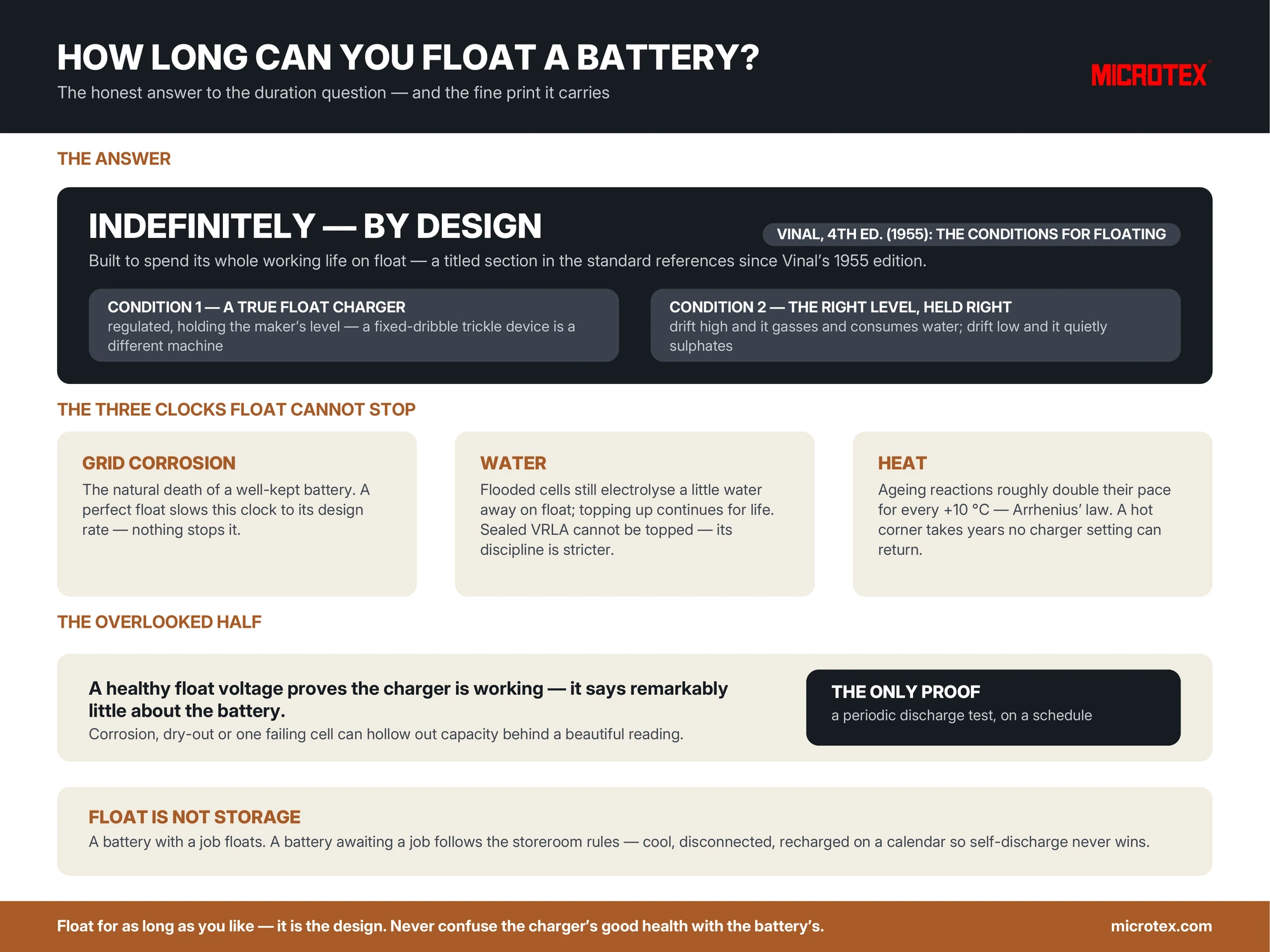
Done properly, float charging has no expiry date: a standby battery is designed to spend its entire working life connected to its float charger — full, quiet and waiting. That is the honest answer to one of the most-asked questions in battery care, and it deserves to be said plainly before the caveats arrive. Telephone exchanges and substations have run batteries this way for generations; the practice was settled enough by the 1950s to hold its own titled section — “The Conditions for Floating” — in Vinal’s classic textbook, whose fourth edition opens it plainly: a battery continuously connected to a bus is said to float. So if you are asking whether the charger can stay connected overnight, over the weekend, or over the decade — with the right machine, yes. It can stay connected for the battery’s whole life. What follows is the fine print that phrase “the right machine” is carrying, and the three clocks that keep running even when everything is done correctly.
Indefinitely is the design — on two conditions
The first condition: it must actually be a float charger. A true float charger is a regulated machine that holds the battery at the finishing level its maker specifies and supplies only the whisper of current the battery asks for. An unregulated “trickle” device pushes a fixed dribble whether the battery wants it or not — a different philosophy with a different ending, and the reason our trickle-versus-float guide exists. Leaving the wrong machine connected for months is not float charging; it is slow cooking. The second condition: the level must be right, and must stay right. Float only earns its “indefinitely” at the correct setting — drift a little high and the cell gasses and consumes water years ahead of schedule; drift a little low and it quietly sulphates while the voltmeter looks respectable. The drift story, and the discipline that catches it, belong to our float charging guide; the numbers belong to your battery’s datasheet, not to any webpage.
The three clocks float cannot stop
“Indefinitely” describes the charging arrangement, not the battery’s lifespan — because three processes continue on float no matter how perfect the setting. The first is grid corrosion: the positive grid corrodes slowly for as long as the cell is charged and connected, which is why corrosion is the natural death of a well-kept battery — the ending our guide to how batteries actually die ranks first among the five killers. A perfect float slows this clock to its design rate; nothing stops it. The second is water: a flooded cell on float still electrolyses a little water away, month after month, so the topping-up ritual continues for as long as the battery does — with the water quality rules our battery water guide insists on. A sealed VRLA cell cannot be topped up at all, which is exactly why its float discipline is stricter, as our VRLA maintenance guide explains. The third clock is temperature, and it is the cruellest: the ageing reactions inside a battery roughly double their pace for every ten degrees Celsius of extra heat — Arrhenius’ law, unpacked in our guide to why heat ages batteries. A stationary battery floated at its design temperature can meet the long service the class is known for — the “full for twenty years” expectation our float guide describes; the same battery floated in a hot, unventilated corner will not, and no charger setting can buy those years back.
Float is not storage
A distinction worth one paragraph, because the two get confused. Float is a duty arrangement: the battery is online, held at readiness, backing a load that may call on it at any second. Storage is an offline arrangement: the battery rests cool and disconnected, and is recharged on a calendar so self-discharge never wins — the drill our guide to storing batteries in stock lays out. Both are legitimate; they answer different questions. A battery with a job floats. A battery awaiting a job follows the storeroom rules. What a battery should not do is sit connected to a charger nobody chose deliberately, in a corner nobody checks — that is not float or storage, just neglect with electricity.
After years on float: is it still a battery?
Here is the uncomfortable half of “indefinitely”, and the reason this page will not end at the reassurance. A healthy float voltage proves the charger is working; it says remarkably little about the battery. A bank can float for years, reading beautifully every morning, while corrosion, dry-out or a single failing cell hollow out the capacity behind the number — the standby that will not stand by. The defences are unglamorous: the walk-round log with its cell readings, where one drifting cell announces itself early, and the periodic discharge test, which our battery testing guide is blunt about — it sits at the top of the hierarchy because it is the only proof. So the full answer to the question in the title runs: float for as long as you like — it is the design — but never confuse the charger’s good health with the battery’s, and make the bank prove itself on a schedule. If your battery has floated for years and nobody has asked it to demonstrate its capacity, tell us the duty and the bank — we will help you plan the test that answers the question the voltmeter cannot.