
The most demanding charging bay in industry is the one you cannot open a window in. On the surface, a battery room breathes through fans and louvres sized with comfortable margins; underground, every cubic metre of fresh air is engineered, accounted for, and shared with the people who breathe it. Yet battery fleets — the locomotives, utility vehicles and scoops that electrify a modern mine — must charge somewhere below, every shift, close to where they work. The answer the industry evolved is the underground charging station: part electrical installation, part ventilation structure, part discipline. The classic American text on mine power puts it plainly: special charging stations are required in underground mines, designed and constructed to meet specific ventilation requirements — and because mine layouts vary endlessly, what transfers between mines is not a drawing but a set of principles. This guide walks through those principles, as a companion to our underground mining batteries guide.
Ventilation first: the station is a gas problem before it is an electrical one
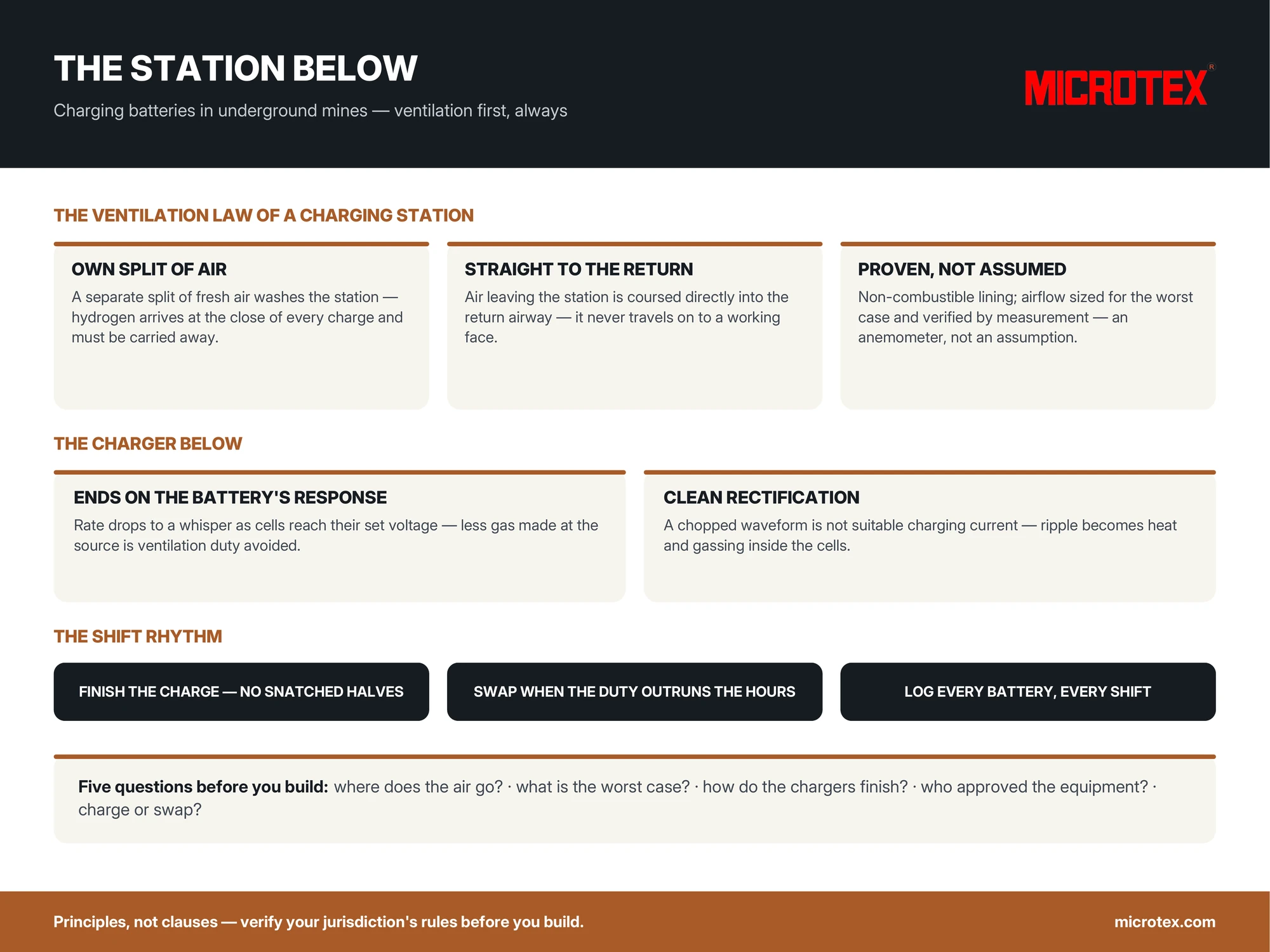
A lead-acid battery on charge is quiet until the end, when the cells approach full and begin to gas — hydrogen, liberated at the close of the charge cycle, exactly the end-of-charge event our battery-room hydrogen guide times and quantifies for surface rooms. Underground, the same physics meets a harder room: the air that dilutes that hydrogen is the mine’s ventilation air, and it must be deliberately routed. The practice the American mine-power literature describes — written for US federal rules, and worth knowing wherever you mine — is a station with its own split of fresh air, arranged so that air passing over the chargers is coursed directly into the return airway rather than onward to working faces. That is why charging stations so often sit in a crosscut beside a return: fresh air washes the station, picks up whatever the batteries breathe out, and leaves the mine without meeting anyone. The station’s walls follow the same logic — lined with non-combustible material so no exposed coal faces the electrical room. And the proof is by measurement, not assumption: the dilution airflow is verified with an anemometer against the worst case the station can host, the same measure-then-trust habit that runs through all good battery practice. Your own jurisdiction’s rules — in India, the DGMS regime — will state their own requirements: verify locally before building anything, because this page teaches principles, not clauses.
The charger below: gentler endings, honest supply
Two things distinguish a charger that belongs underground. First, how it finishes: the gassing problem is largely a charger problem, and the mine-power text notes that modern chargers limit it by automatically dropping the charge rate to a very low value once cells reach a set voltage — the response-based ending our charging guides teach, doing safety duty as well as battery-life duty. A charger that overdrives the finish makes gas the ventilation must then carry; a charger that ends on the battery’s response makes less of the problem in the first place. Second, what it is fed: mine power systems are long, hard-worked distribution networks, and the same text observes drily that a chopped waveform is not entirely suitable for battery charging — rectification quality matters, because ripple becomes heat and gassing in the cells. This is why we treat the battery and its charger as one engineered pair — our mining battery charger page describes the machines we build for exactly this room, matched to the mining locomotive batteries and MUV and scoop batteries they serve.
The shift rhythm: charge, swap, breathe
An underground fleet lives by rotation. A locomotive works its shift, comes to the station, and either charges through the off-shift or exchanges its drained battery for a charged one and returns to work — the swap model our battery swapping guide shows has quietly run in industry for decades, and which earns its keep hardest where a vehicle cannot be spared for the hours a proper charge takes. Two disciplines keep the rotation honest. The charge must FINISH: snatched half-charges between runs are how underground batteries slide into the partial-state-of-charge life that breeds sulphation — if the duty needs opportunity charging, it must be engineered as such, not improvised. And the station’s housekeeping is the surface drill, underground: vent plugs fitted and breathing, tops clean and dry, no metal tools resting on cells, watering done at the end of charge with the station’s ventilation running, every battery’s readings logged. The ignition rules need no re-invention below — they are the same habits our hydrogen safety guide teaches, applied where the margin for casualness is smallest.
What to ask before you build or upgrade a station
Five questions sort most projects. Where does the station’s air go? — if the answer is not “directly to the return”, start there. What is the worst case? — the largest number of the largest batteries that could ever charge at once sets the ventilation duty, not the average day. How do the chargers finish? — response-ended machines make less gas; ask to see the end-of-charge behaviour, not just the nameplate. Who approved the equipment? — underground electrical equipment carries approvals specific to your jurisdiction and mine type; in India that conversation runs through DGMS, and the equipment pages, not this guide, carry our approval positions. Does the rotation match the duty? — count vehicles, shifts and charge hours honestly, and the answer will tell you whether you are running a charging station or a swap station. If you are planning one — a new fleet, a deeper level, a diesel replacement — describe the mine and the fleet to us: batteries, chargers and the charging plan come better from one hand than three.