
A charged battery has no off switch, and the only things that limit the current it will push into a fault are its own internal resistance and the wire you have connected to it. Linden’s Handbook of Batteries defines short-circuit current as the initial current a battery delivers into a circuit of negligible resistance. For an industrial lead-acid bank that current is large enough to burn a careless hand, wreck cable insulation and start a fire before anyone reaches the disconnector.
Where the number comes from
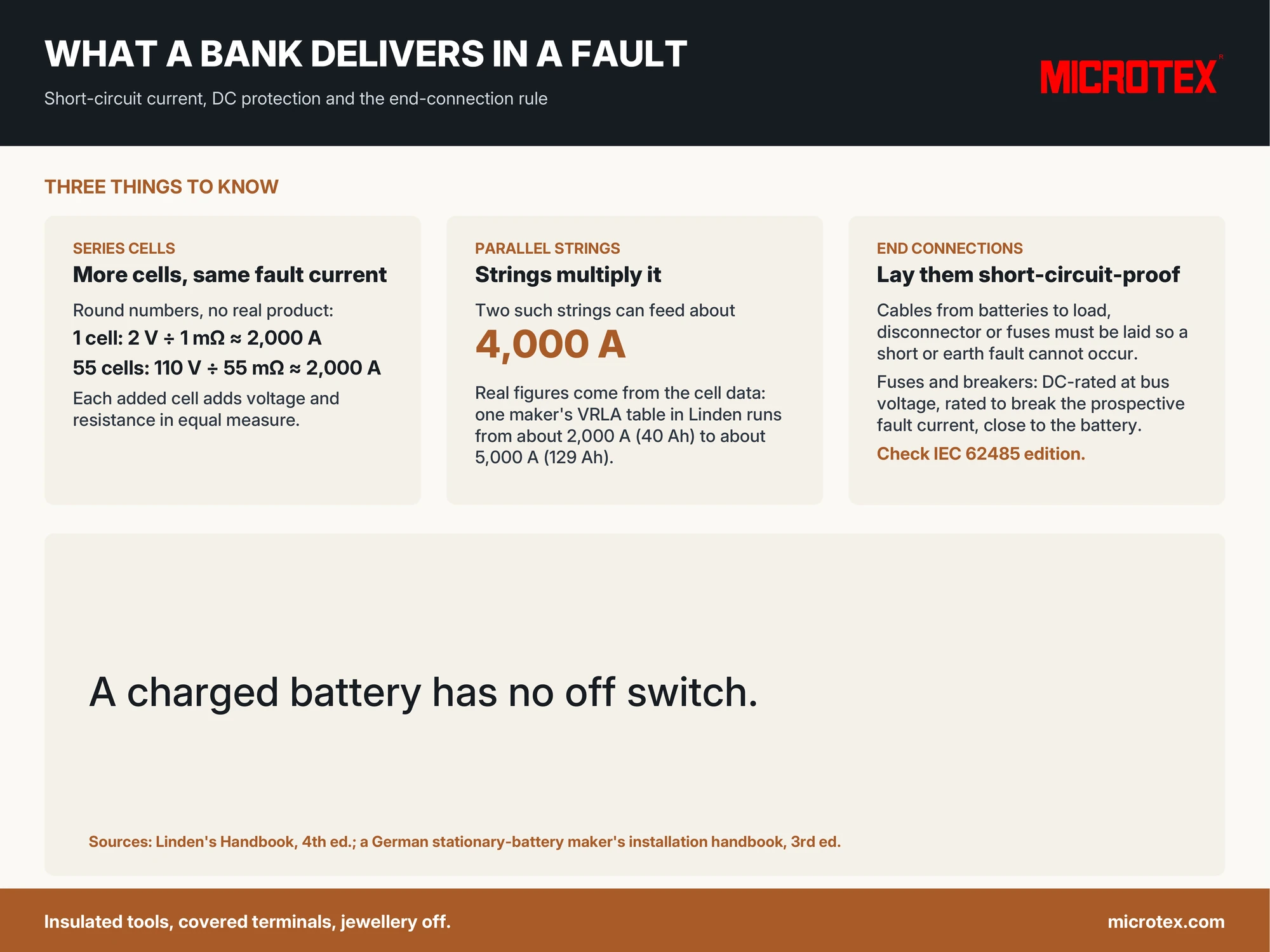
Ohm’s law does the work. Fault current is roughly the battery’s open-circuit voltage divided by the total resistance in the loop: the cells’ own internal resistance, the connectors, and the cable to the fault. One consequence comes from our own arithmetic rather than from any handbook. Adding cells in series does not raise the fault current, because each added cell adds voltage and internal resistance in equal measure. Take round numbers that belong to no product: a cell of 2 V and 1 mΩ gives about 2,000 A, and fifty-five of them in series give 110 V behind 55 mΩ, which is still about 2,000 A. Connectors and cable add resistance and pull the figure down. What multiplies the fault current is parallel strings: two such strings can feed about 4,000 A.
Real numbers come from the cell’s own data. Linden reproduces one maker’s data for VRLA blocks in which short-circuit current rises from about 2,000 A for a 40 Ah block to about 5,000 A for a 129 Ah block, with impedance falling from 4.5 mΩ to 2.0 mΩ. Those are one design’s figures, not a universal.
The hazard at the bench
Linden’s chapter on valve-regulated cells warns that their low impedance means high current into an external short, with heat enough for severe burns and a fire hazard, and singles out rings, watchbands and metal tools across open terminals. The handbook’s chapter on battery safety says the same from the designer’s side: keep the terminals physically isolated and recessed where you can. In the field that means insulated tools, covered terminals on every cell you are not working on, and jewellery off. Our guides to battery safety and to handling and lifting industrial batteries say more.
The rule for the end connections
A German stationary-battery maker’s installation handbook (3rd edition, 2008) draws a line worth knowing. The short connectors between cells or blocks, and between rows and tiers, need not be inherently short-circuit-proof, because installation standards treat them like wiring inside an appliance. But every end connector, meaning the cables that join batteries to each other, to the load, to the disconnector or to fuses, must be laid so that a short-circuit or earth fault between conductors cannot occur. The handbook’s examples are single-core rubber-insulated flexible cable and single-core non-sheathed layouts to German VDE rules, and it points to EN 50272-2 for comparison. The IEC 62485 series now covers battery installation safety, with part 2 for stationary batteries; check which edition applies in your market before writing either into a specification.
The protective device
The device guarding those end connections has three jobs. It must be rated for direct current at the bank’s full voltage, because a DC fault has no natural current zero to help the device interrupt, so an AC-rated device is not a substitute. It must be rated to break the prospective fault current, the most the bank could deliver, which is why you need the cell’s published figure and the number of parallel strings. And it must sit close to the battery, because the cable between battery and fuse is unprotected. This is general electrical engineering rather than a battery-handbook finding, so take the actual ratings from the device maker’s data. Linden’s appendix on failure analysis makes the related point that high-rate batteries typically require protection against short circuit, while lower-rate batteries may be limited by their own internal resistance. An industrial stationary bank belongs firmly in the first group.
Small faults leave the same signature
Every poorly made connection carries the same current, only as heat at a smaller scale: a loose intercell connector is a hot spot during any heavy discharge, which is why our guides to battery commissioning and to sizing the cables and connectors between cells ask you to record torque and the first resistance reading. An earth fault on one pole is also the first step towards a short-circuit between poles; see DC earth faults and the battery room.
What to ask, and of whom
Ask the battery maker for the cell’s short-circuit current and internal resistance at a stated temperature, and for the maximum discharge current and its duration; our guides to reading a battery datasheet and to internal resistance help you read the answers. Ask the panel builder for the DC rating and breaking capacity of every device at your bus voltage. Ask the installer how the end connections are insulated and routed. Three documents, three answers, one calculation. Send us your bank configuration and we will supply the cell data your fault-level calculation needs.
Sources quoted: T. B. Reddy (ed.), Linden’s Handbook of Batteries, 4th ed. (McGraw-Hill, 2011), glossary, chapters 5 and 17, and appendix on failure analysis; Handbook for Stationary Lead-Acid Batteries, Part 1: Basics, Design, Operation Modes and Applications, 3rd ed. (a German stationary-battery maker, December 2008).