
A traction battery is a set of 2 V cells in a steel tray, and the code on each cell tells you most of what is needed to order its replacement. This guide is for the buyer who needs cells rather than a whole battery: to replace failed cells, re-cell a sound tray or specify a new battery cell by cell. For the truck side, see our explainer on what a traction battery is and our guide to ordering a replacement forklift battery; this post stays with the cell.
The cell is the unit of construction
No two fleets want the same battery, so the trade standardises the cell and builds the tray around it. Linden’s handbook describes the result: a coated steel tray, cells packed and shimmed, connectors welded between them. Because the battery is an assembly of separable cells, one or a few can be replaced when they fail, a point Jung, Zhang and Zhang make in their account of traction cell design.
Reading the cell code
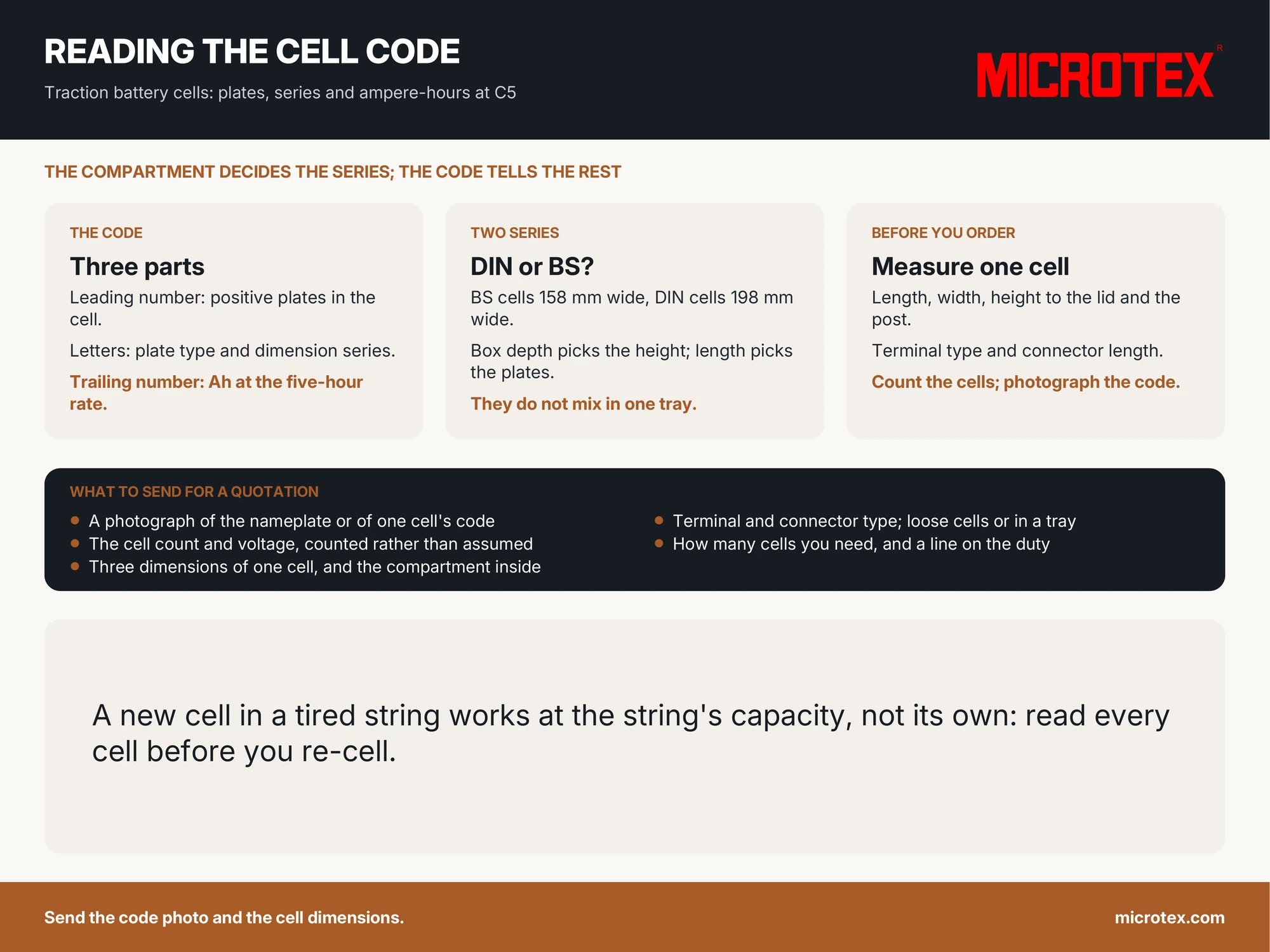
The code has three parts. The leading number is the count of positive plates in the cell. The letters name the plate type and the dimension series. The trailing number is the capacity in ampere-hours at the five-hour rate (C5). The plate count leads because traction cells are rated on the positive plate: Linden’s handbook gives the cell rating as the capacity of one positive plate multiplied by the number of positives, with one more negative than positive in every cell. On a Microtex nameplate, 7MIPzB 602 reads as seven positive plates of 86 Ah each, PzB for the BS-dimension tubular cell, and 602 Ah at the five-hour rate; a DIN-dimension cell carries PzS. Other makers use their own prefixes; photograph the code and we translate it before we quote.
DIN or BS: the compartment decides
Dell and Rand state the rule: traction cells are made to one standard width, with length and height varying, and they give the British Standard width as 159 mm and the German DIN width as 198 mm. Our BS-series cells are 158 mm wide, take 2 to 13 positive plates and run from 42 to 1404 Ah, in heights from 231 to 716 mm; our DIN-series cells are 198 mm wide, take 2 to 10 positive plates and run from 100 to 1550 Ah, in heights from 309 to 745 mm, all at the five-hour rate at 30 °C. The two series do not mix in one tray. Width fixes the series, the depth of the compartment or battery box fixes the plate height, and the length left for each cell fixes how many plates it can hold; the ampere-hours you would like come last, because the box has already decided them. IEC 60254-2:2008 sets the maximum overall dimensions, terminal dimensions and polarity marking for traction cells, adopted in India as IS 5154 (Part 2):2013. The national standards behind the two dimension series, DIN 43595 of 1981 and BS 2550 of 1983, are withdrawn, yet PzS and PzB live on as trade shorthand; check the current edition of any standard before writing it into a specification.
Compare capacities at the same rate
Traction cells are rated at the five-hour rate, the convention of IS 5154 (Part 1) and IEC 60254-1, whose 2005 edition carries the general requirements and test methods. A nameplate printing a ten-hour or twenty-hour figure describes a gentler duty and a larger number for the same cell, so put every quotation on one rate; our guide to C-rate shows how far the figures drift.
A few cells, or the whole tray?
Replacing cells is right when the fault is local and the rest of the string is sound: a cracked container, a broken post, an early failure among neighbours that read well on specific gravity and voltage. It is wrong when the fault is age. In a series string every cell carries the same current, so the battery delivers the capacity of its weakest cell; a new cell dropped among tired ones is held to their capacity and never works to its own rating. This is our reasoning from the series circuit; our post on one weak cell in a string sets out the mechanism. The honest test is the cell readings, not the string voltage (our guide to traction battery service and repair covers them): if most cells read alike and the set is near the end of its life, re-cell the whole tray or replace the battery.
Measure before you order
- Cell length and width, and the height to the top of the lid and of the terminal, in millimetres.
- Terminal type, bolted or welded; our cells carry bolted M10 posts with tin-plated copper inserts.
- Connector type and length between cells, and which cells the end cables leave from; see our guide to sizing cables and connectors.
- The number of cells and the nominal voltage, counted rather than assumed.
- The old code and the ampere-hours as printed, with the rate if the plate states one.
- The inside dimensions of the compartment or battery box and the clearance under the lid.
Cells or a complete battery in a tray?
Order cells when the tray and connectors are sound, or when the old maker no longer supplies and the fleet standard must be kept. Order a complete battery when the tray is corroded, when voltage or capacity changes, or when the truck is new to you: it arrives assembled, factory-charged or dry-uncharged, with its charging specification. For pallet trucks, scrubbers and other light duty the right answer is sometimes a monobloc rather than 2 V cells; our post on semi-traction batteries says when. For round-the-clock fleets charged in short breaks, lithium may serve better than any lead-acid cell. Three of our cell types were capacity-tested at the five-hour rate at CPRI Bengaluru in 2025, as our product pages state.
What to send for a quotation
Send a photograph of the nameplate or of one cell’s code, the cell count and voltage, the three dimensions of one cell and the inside of the compartment, the terminal and connector type, how many cells you need and whether loose or in a tray, and a line on the duty. Our forklift battery and mining locomotive battery pages carry our DIN and BS cell range tables; both state the first reply comes within the working day and every size is delivered in 21 days. Send the photograph and the measurements and we quote the cells, connectors and covers with a delivery date.
Sources quoted: T. B. Reddy (ed.), Linden’s Handbook of Batteries, 4th ed. (McGraw-Hill, 2011), chapter 16, sections on traction cell assembly, traction performance and plate sizes; R. M. Dell and D. A. J. Rand, Understanding Batteries, 1st ed. (Royal Society of Chemistry, 2001), section 8.6, tubular traction batteries; J. Jung, L. Zhang and J. Zhang, Lead-Acid Battery Technologies: Fundamentals, Materials, and Applications, 1st ed. (CRC Press, 2016), section 1.7.2, deep-cycle and traction batteries. Standards named: IEC 60254-1:2005, IEC 60254-2:2008, IS 5154 (Part 1) and (Part 2):2013, DIN 43595:1981 (withdrawn), BS 2550:1983 (withdrawn); verify the current edition before relying on any of them.