
Cold rewrites three battery rules at once: the battery holds less, accepts charge more slowly, and needs a HIGHER charging voltage — while a discharged battery gains a fourth problem: it can freeze solid. Most charging advice is written for a pleasant 25 °C. Here is what changes when the battery room, the telecom shelter on a mountain, or the cold-store warehouse floor is nowhere near that.
Cold battery, smaller battery, slower battery
Every process inside a lead-acid cell runs on ions moving through acid, and cold acid is thick, reluctant acid. Discharge capacity falls as temperature drops — a battery rated at 27 °C delivers meaningfully less of itself in the cold, and the faster you draw, the worse it gets (the same rate arithmetic as C-rate, with temperature leaning on the scale). Charging suffers equally: charge acceptance drops, so a cold battery wants more voltage and more time to reach genuine full charge. Skimp on either and the battery spends its winter chronically undercharged — which is exactly how sulfation earns its keep in cold climates.
Temperature compensation — the cold side of the slope
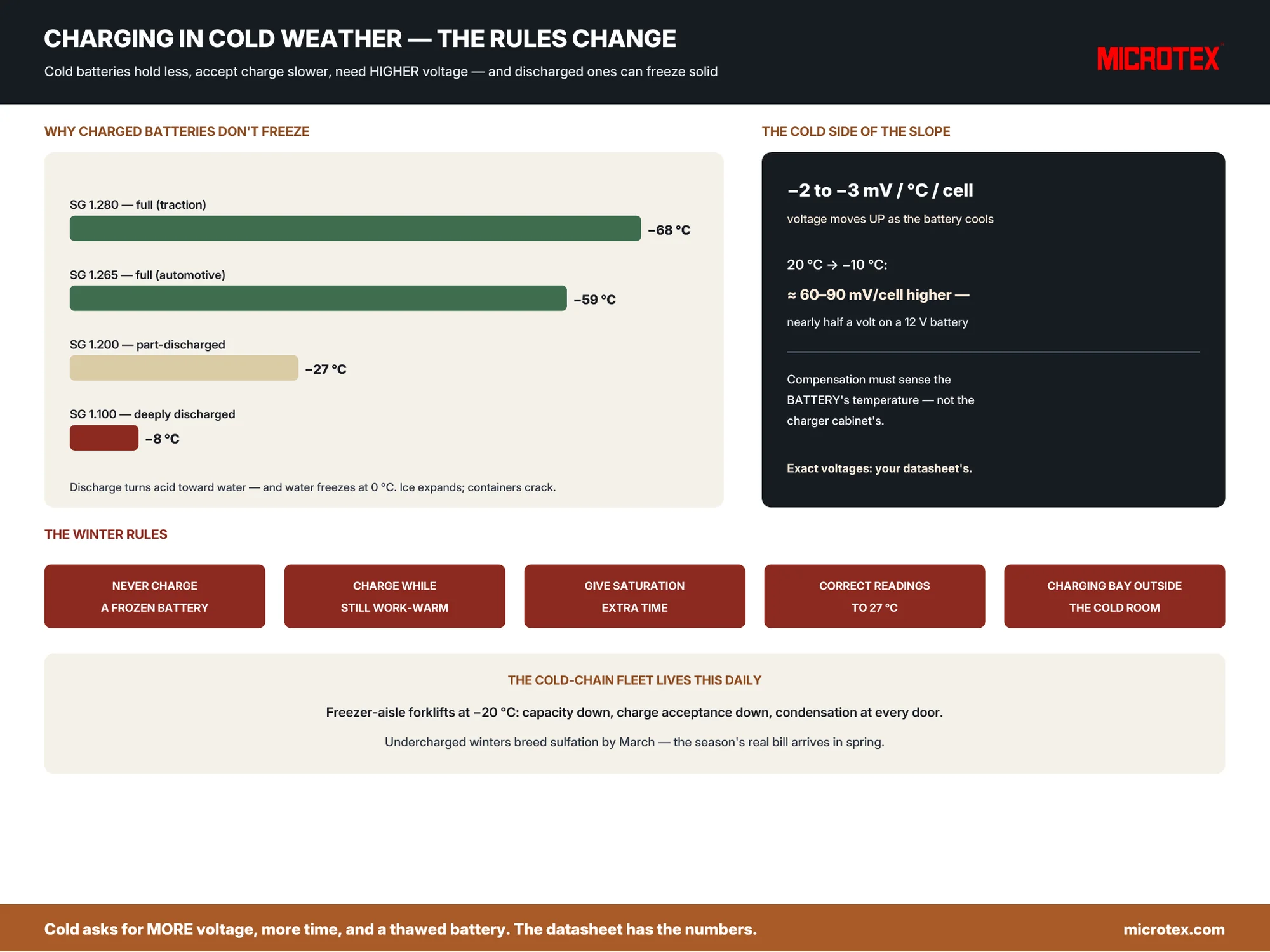
Float charging taught the hot side of this rule: charging voltage moves with temperature by about −2 to −3 mV per °C per cell, downward as the battery warms. Cold simply runs the slope the other way — UPWARD as the battery cools. The arithmetic is worth feeling once: a setting correct at 20 °C is roughly 60–90 mV per cell too LOW at −10 °C — on a 12 V battery, nearly half a volt of missing charge voltage, every day, all winter. That is why a charger with genuine temperature compensation (sensing the BATTERY’s temperature, not its own cabinet) is not a luxury in cold service; it is the difference between a charged fleet and a sulphated one. The exact voltages, as always in this series, are your datasheet’s — what is universal is the direction and the slope.
The freezing table — why charged batteries don’t freeze
| Electrolyte specific gravity | State it implies | Freezes at about |
|---|---|---|
| 1.280 | Fully charged (traction class) | −68 °C |
| 1.265 | Fully charged (automotive class) | −59 °C |
| 1.200 | Part-discharged (or stationary full charge) | −27 °C |
| 1.100 | Deeply discharged | −8 °C |
Now the series’ old proverb — “a charged battery resists freezing” — has its numbers. Discharge converts acid toward water, and water freezes; a deeply discharged battery can freeze on an ordinary frosty night, and freezing electrolyte expands (the beer-bottle-in-the-freezer effect), cracking containers and buckling plates. Note the third row carefully: stationary OPzS-class cells run ~1.20 gravity even when FULL, so their honest margin is about −27 °C — ample for any Indian site, worth checking for Himalayan and export installations. The full gravity story lives in the battery acid guide.
The cold-weather charging rules
Never charge a frozen battery. If electrolyte has frozen or slushed, bring the battery indoors and let it thaw completely first — charging a frozen cell risks container damage and worse. Charge while warm if you can: a battery that comes off shift or off the vehicle still carries working warmth; charging then beats charging after a cold soak. Give it the time: cold charge acceptance is slow, so the saturation phase from the charging guide matters even more — snatched winter charges are how fleets sulphate by March. Verify with the hydrometer, corrected: gravity readings must be temperature-corrected to 27 °C, and cold readings correct DOWNWARD — an uncorrected winter reading flatters the battery. Watch the cold-store fleet: forklifts working −20 °C freezer aisles live this post daily — capacity down, acceptance down, condensation on every transition; their charging bay belongs OUTSIDE the cold room, and their duty deserves the engineered plan on the traction battery guide.
And if the battery is going to sit idle through the season rather than work through it, that is a different discipline — the winter storage guide covers hibernation properly. Terms in the glossary; a cold-climate installation that keeps coming up short belongs in an enquiry — sizing for real site temperature is exactly the arithmetic we like showing.