
Every other component in a battery has an obvious job; the separator’s job is to do nothing, and it is the hardest job in the box. It must hold two plates apart without obstructing the ions travelling between them, survive years in hot acid beside an electrode that is chemically trying to burn it, stop the debris of ordinary ageing from bridging a short circuit — and add as little electrical resistance as physically possible while doing all of it. Nobody writes a separator into a purchase specification and nobody asks about it at the quotation stage, yet it is one of the two or three components that most reliably decides whether a battery reaches its rated life or dies quietly in year three. This is the guide to the part you have never thought about.
Four jobs that contradict each other
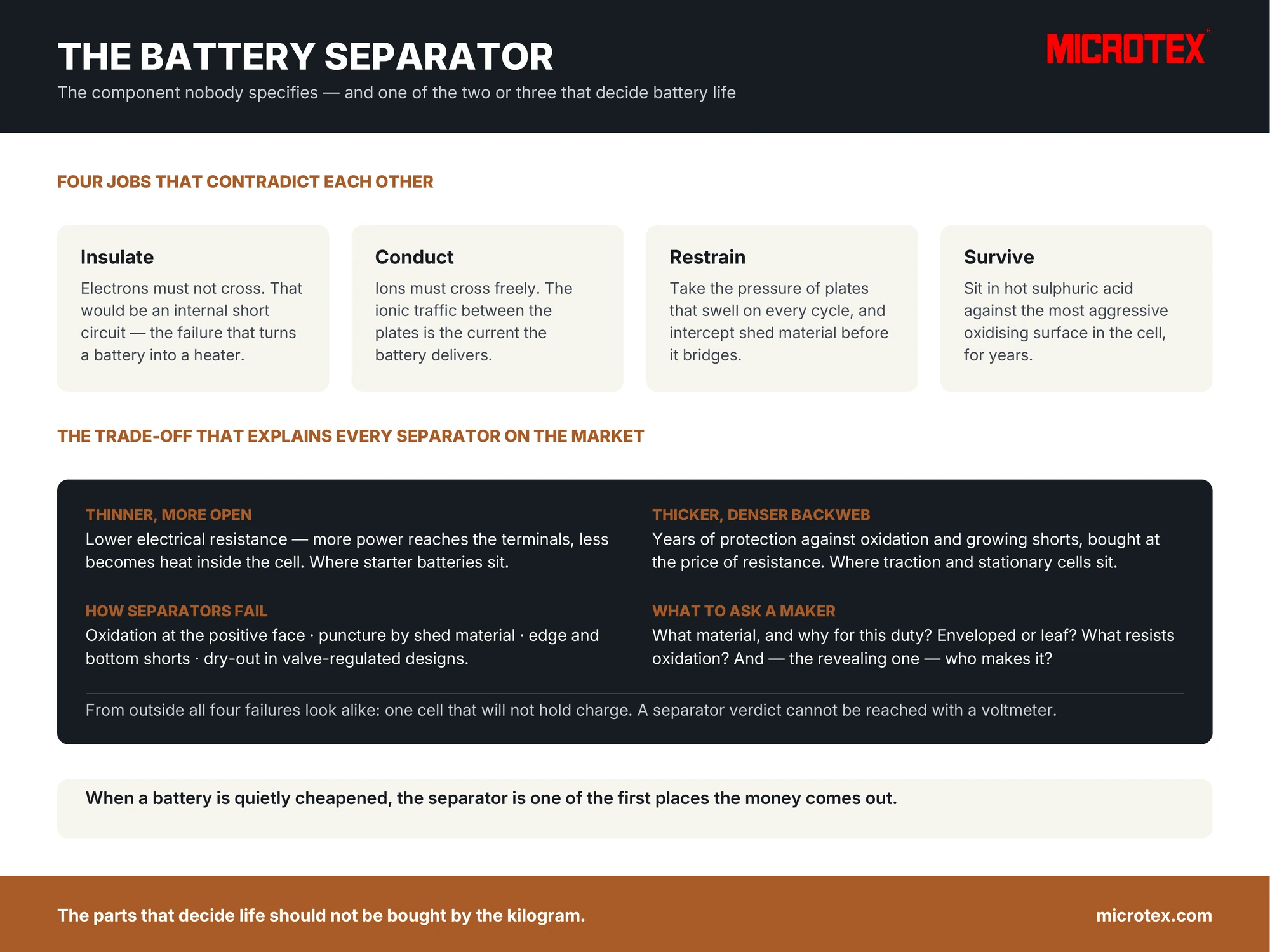
A separator has to be an electronic insulator and an ionic conductor at the same time. Electrons must not cross it — that would be an internal short circuit, the failure that turns a battery into a heater. Ions must cross it freely, because the ionic traffic between the plates is the current the battery delivers, as our guide to where two volts comes from sets out. It must also be mechanically real: strong enough to take the pressure of plates that swell and contract on every cycle, and to intercept the active material that inevitably sheds from an ageing positive plate before it can settle into a bridge. And it must be chemically inert in hot sulphuric acid while pressed against the most aggressive oxidising surface in the cell. Insulate, conduct, restrain, survive. Every separator ever made is a negotiated settlement between those four demands.
The trade-off that explains every separator on the market
The negotiation reduces to one axis. A thinner, more open separator means lower electrical resistance, so more of the battery’s power reaches the terminals and less of it becomes heat inside the cell — welcome news for anyone reading our guide to internal resistance. But thin and open is also fragile: less material between the plates to resist oxidation, fewer obstacles to a growing short, less mechanical support for a positive plate that wants to shed. Push the other way — a thicker, denser backweb with finer pores — and you buy years of protection at the price of resistance and power. Starter batteries, which must deliver enormous current for a few seconds and then rest, sit at the thin end. Traction and stationary cells, which must survive a decade of abuse, sit at the thick end. When a battery is quietly cheapened, the separator is one of the first places the money comes out, because the customer cannot see it and the consequence arrives years after the invoice.
The materials family
Microporous polyethylene is the modern workhorse: a polymer sheet loaded with fine silica to open a network of pores, flexible enough to fold into an envelope around the plate and tough enough for factory handling. Microporous rubber has an old and honourable reputation in deep-cycling duty for its resistance to oxidation. Polyvinyl chloride separators, moulded or sintered, remain widely used in industrial cells for their stiffness and chemical endurance. Glass mat is the special case: in an absorbent glass mat battery the separator is not merely a spacer but the electrolyte’s container and the pathway for the oxygen cycle — which is why it must be held under controlled compression, and why an AGM design cannot be built with any plate geometry you please. Gel reaches the same end differently, immobilising the acid in a silica matrix; our AGM versus gel comparison weighs the two honestly.
One frequent confusion is worth settling. The woven sleeve around a tubular positive plate — the gauntlet — is not a separator. It is part of the plate: its job is to hold active material against the spine while the plate breathes through thousands of cycles, and it is the reason a tubular plate outlives a flat one. A tubular cell still needs a separator between the tubular positive and the pasted negative. Two different components, two different jobs, frequently sold as one word.
How separators fail — and what it looks like from outside
There are four routes, and each has a signature. Oxidation: the face pressed against the positive plate lives in a chemically hostile place, and over years an inadequate material embrittles, thins and eventually perforates. Puncture: shed active material or a growing crystal finds a weak point and the plates touch. Edge and bottom shorts: debris settles or creeps around an unenveloped separator’s edges — historically the commonest short of all, and the reason enveloping the plate rather than merely leafing a sheet between plates was such a quiet revolution; it also allowed the sediment space beneath the plates to shrink, buying capacity in the same box. Dry-out: unique to valve-regulated designs, where the mat is the electrolyte’s home — lose water and you lose contact, and the cell’s resistance climbs while its capacity falls. From outside, all four look the same at first: one cell that will not hold charge, or a cell that runs warmer than its neighbours, or a bank whose readings drift apart. Which is precisely why our published post-mortem method ends in a teardown — a separator verdict cannot be reached with a voltmeter.
What a buyer can actually ask
You will not be able to audit a separator, but four questions tell you a great deal about the maker. What material is it, and why that material for this duty? Is the plate enveloped, or is a leaf separator used? What in the design resists oxidation on the positive face, given that this is where separators age? And — the question that reveals most — who makes it? A battery builder who buys separators from whoever is cheapest that quarter is making a different product from one who controls the component. We make our own, and we say so for the same reason we say it about our plates: the parts that decide life should not be bought by the kilogram. If you are comparing two quotations that look identical on ampere-hours, the difference is usually hiding in components like this one — send us both specifications and we will tell you what to ask each supplier, ourselves included. The wider anatomy is in our complete guide to the lead-acid battery; what finally kills a cell is set out in how batteries actually die.