
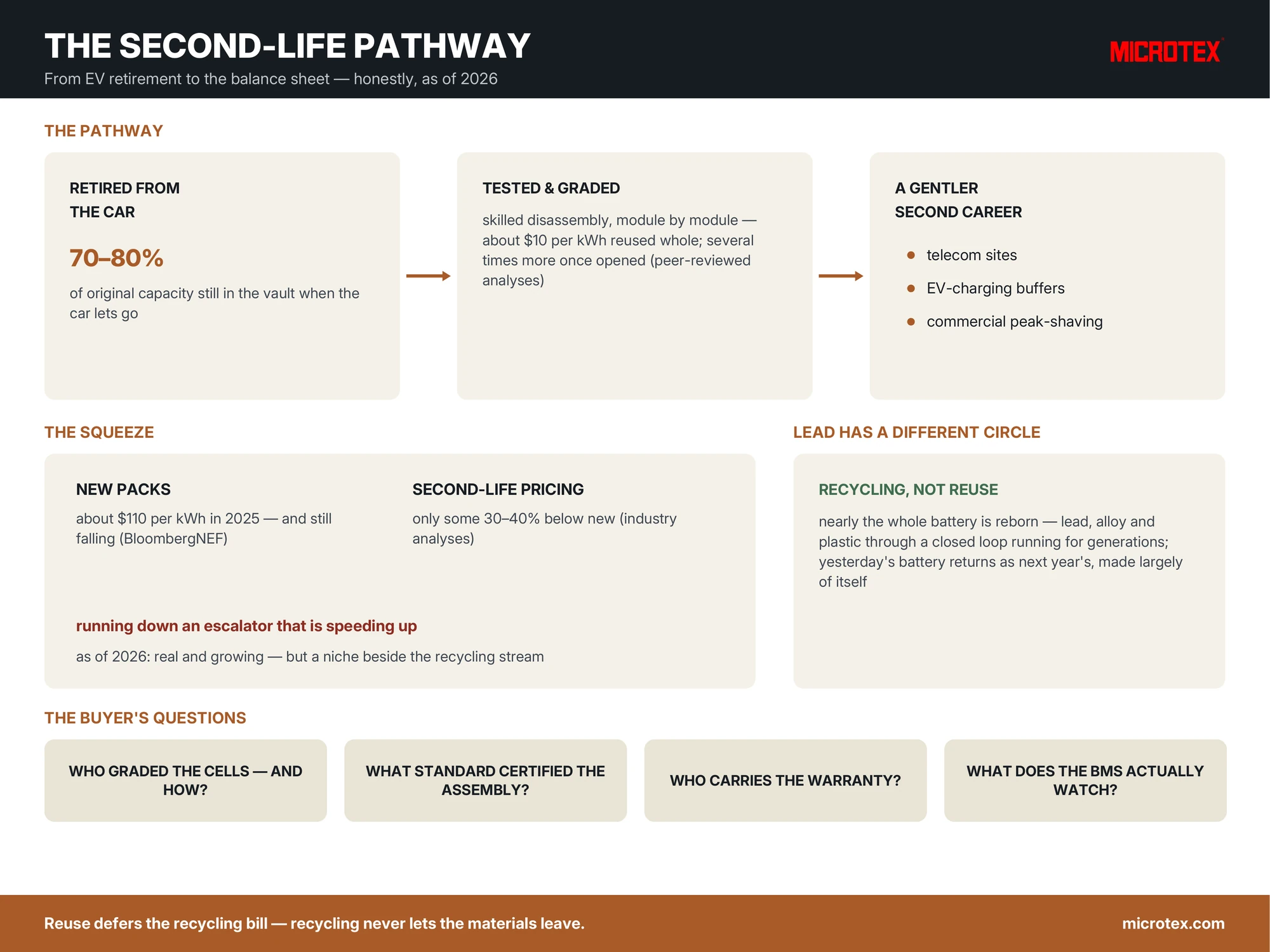
An electric car’s battery retires with most of its life savings still in the vault. The industry convention is that an EV pack comes out of the car at around 70 to 80% of its original capacity — not because it has stopped working, but because a car is an unforgiving employer: range has shrunk, fast-charging has slowed, and the driver notices. Yet a pack at three-quarters strength still holds a very large amount of useful energy, and an obvious idea follows: give it a gentler second career storing solar power or backing up a building. That idea now has an industry, a name — second-life batteries — and a gap between its brochure and its balance sheet. This is the honest guide to both.
The idea, and why the engineering makes sense
Vehicle duty is among the hardest a battery can serve: violent discharge currents, fast charging, vibration, parking-lot heat — the full assault course, as our guide to electric vehicles describes. Stationary duty is the retirement posting: gentle rates, controlled temperature, no vibration, and capacity fade that costs nothing worse than a somewhat smaller bank. A pack that can no longer promise a family 300 kilometres can still absorb rooftop solar all afternoon, and the arithmetic of embodied effort argues for using it: every retired pack already carries its mining, refining and manufacturing burden, so a second working decade spreads that burden across more delivered energy. Repurposed packs are already doing real work — telecom sites, EV-charging buffers, commercial peak-shaving, small storage systems — and the engineering logic behind every such installation is sound. The difficulties live elsewhere.
The frictions the brochures skip
Friction one: NO TWO PACKS ARE ALIKE. Every carmaker’s pack is a different shape, chemistry, connector and software lock, so repurposing begins with skilled manual disassembly and per-module testing and grading — labour that peer-reviewed economic analyses put at around ten dollars per kilowatt-hour when a pack can be reused whole, and several times that once it must be opened into modules. Friction two: PAPERWORK. A retired pack arrives with no warranty and an unknown biography, and turning it into a sellable product means certification (UL publishes a dedicated standard for evaluating repurposed batteries) and someone willing to carry the liability when a seven-year-old cell fails in year twelve. Friction three — the quiet killer: NEW CELLS KEEP GETTING CHEAPER. Per BloombergNEF, new lithium-ion pack prices fell to around $110 per kilowatt-hour in 2025 and industry analyses put typical second-life pricing only some 30 to 40% below new. A used pack with grading costs, shorter remaining life and thinner warranty, competing against a new pack whose price falls every year, is running down an escalator that is speeding up. As of 2026 the honest summary is: real deployments exist and grow, but second-life remains a niche beside the recycling stream, and the economics get harder, not easier.
The safety questions a buyer should ask
A second-life pack carries its history invisibly. Was it crashed? Flooded? Fast-charged daily in desert heat? Cells with different pasts age at different speeds, and a string mixing strong and weak cells stresses its weakest members hardest — risk that professional repurposers manage with per-module grading, conservative limits, fusing, and a proper battery management system watching every cell. Buy from that end of the market and the risk is engineered; it is the other end that worries fire services — salvage cells of unknown history assembled into home-made storage walls, which is where a disproportionate share of incident reports originate. The buyer’s questions are simple: who graded the cells and how, what standard was the assembly certified to, who carries the warranty, and what does the BMS actually monitor. A seller with crisp answers is selling engineering; a seller without them is selling someone else’s fatigue.
Lead’s different circle — recycling, not reuse
Now the contrast this site owes you. Lead-acid’s circularity runs on the opposite model: not REUSE but RECYCLING. A worn lead battery is rarely worth redeploying — its plates age as one assembly, as our battery-life guide explains — but nearly the whole battery is reborn instead: lead, alloy and plastic flow back through a closed recycling loop that has run at industrial scale for generations, and yesterday’s battery returns as next year’s, made largely of itself. Two circularities, honestly compared: reuse stretches a product’s life and defers — but does not escape — the recycling bill, which for lithium is still being industrialised; recycling forgoes the second career but guarantees the materials never leave the economy. A mature battery industry will need both. Lithium is now building the loop that lead perfected; lead, in fairness, never found much second-life value to harvest. If you are weighing storage options — new lead, new lithium, or somebody’s retired pack — ask us; we will tell you honestly which risks are engineered and which are merely priced attractively.