
An honest guide to lithium-ion — written by a lead-acid house. We compete with this chemistry daily, which is exactly why we refuse to caricature it: lithium-ion is a superb piece of electrochemistry with real strengths, real limits and a Nobel Prize on its shelf. Here is how it came to be, how it works, what the family tree looks like, and where it genuinely beats the battery we make — and where it doesn’t.
Three scientists and a decade-hopping relay
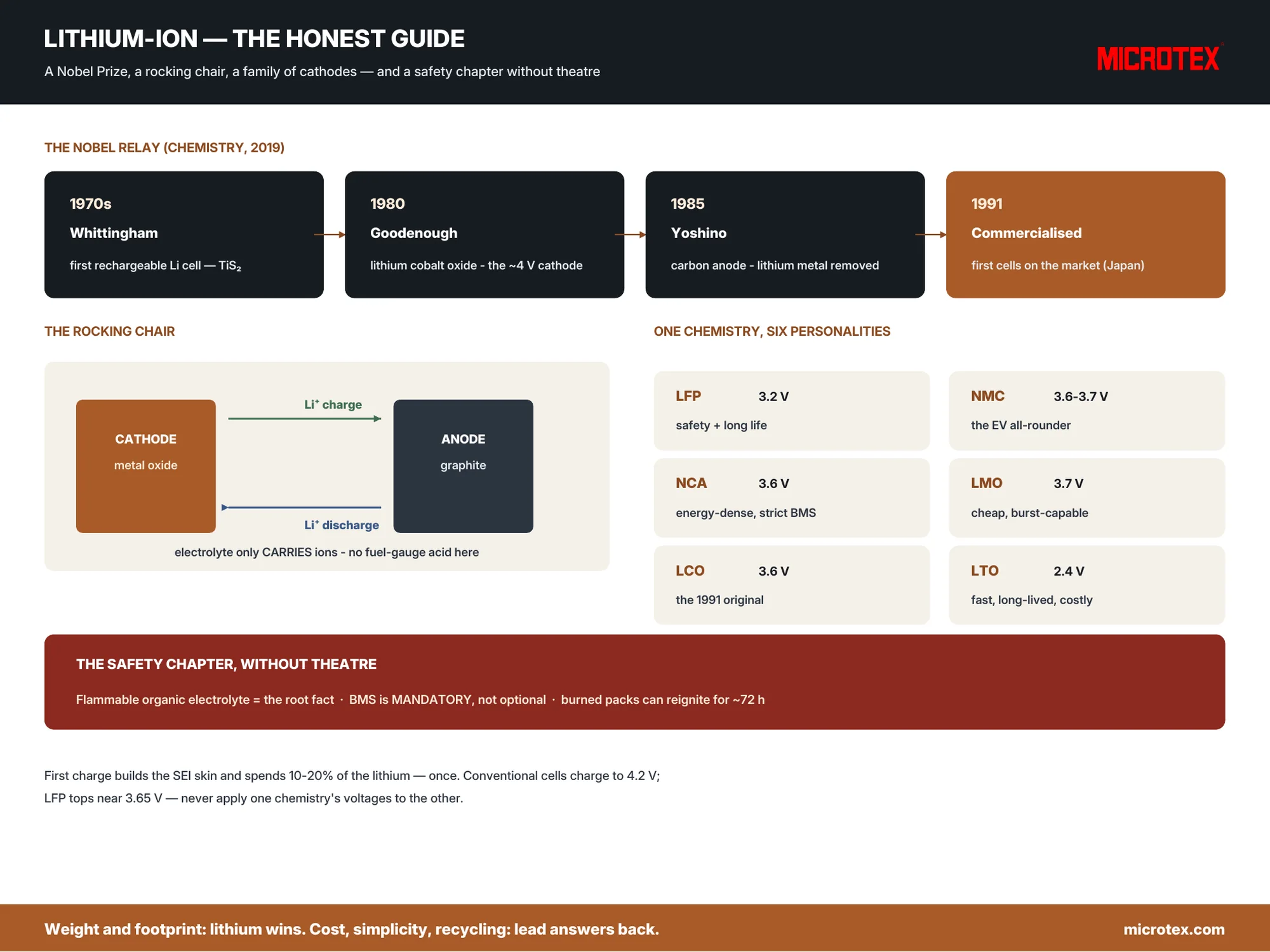
Lithium was always the obvious dream: the lightest metal, with the most negative electrode potential of any — meaning the highest voltage and the least weight per stored electron. Taming it took a relay. In the 1970s, Stanley Whittingham, working at Exxon’s research arm, built the first working rechargeable lithium cell using titanium disulphide — a layered crystal that lithium ions could slide into and out of, a mechanism called INTERCALATION. It worked, but metallic-lithium negatives grew dendrites and cells caught fire. In 1980 John B. Goodenough at Oxford found the cathode that changed everything — lithium cobalt oxide, delivering around 4 volts. And in 1985 Akira Yoshino in Japan removed the dangerous lithium metal entirely, storing lithium in a carbon negative instead, and proved the safety by mechanical abuse tests. A major Japanese electronics maker — Sony — commercialised the result in 1991, and the three scientists shared the 2019 Nobel Prize in Chemistry. Every phone, laptop and EV runs on that relay.
The rocking chair — how it works
A lithium-ion cell is two intercalation hosts facing each other: a metal-oxide cathode and (usually) a graphite anode, separated by a porous polymer film soaked in an organic electrolyte carrying lithium salts. On charge, lithium ions leave the oxide, cross the electrolyte and tuck between graphite layers; on discharge they rock back, driving electrons through your equipment. Note the contrast with lead-acid, whose electrolyte is a consumed ingredient: here the electrolyte only carries ions — nothing about its strength tells you the state of charge, which is why lithium batteries need electronic gauges. Two more consequences matter. On the very first charge, part of the electrolyte deliberately decomposes onto the anode to form the SEI — a protective skin that makes the chemistry possible and consumes roughly 10–20% of the lithium once, which is why cells are formed and aged at the factory. And conventional cells charge to about 4.2 V per cell while the LFP type tops near 3.65 V — the distinction our state-of-charge article flags, because applying one chemistry’s voltages to the other is a classic field error.
One chemistry, a family of cathodes
| Type | Nominal V | Character |
|---|---|---|
| LFP (iron phosphate) | 3.2 | The safety-and-longevity choice; tolerant, long-cycling, modest energy |
| NMC (nickel-manganese-cobalt) | ~3.6–3.7 | The all-rounder; energy and life balanced, dominant in EVs |
| NCA (nickel-cobalt-aluminium) | ~3.6 | Energy-dense, demands disciplined management |
| LMO (manganese spinel) | ~3.7 | Cheap manganese, burst-capable, shorter-lived; often blended |
| LCO (cobalt oxide) | ~3.6 | The 1991 original; consumer electronics territory |
| LTO (titanate anode) | 2.4 | The outlier — fast-charging, extremely long-lived, expensive, low energy |
How cells are made — the short tour
Manufacturing is coating science. Active materials are slurried with a few per cent of conductive carbon and binder, coated tens of micrometres thick onto foils — aluminium (~15–20 µm) for the cathode, copper (~10 µm) for the anode — dried, calendered, and slit. A porous separator film 10–25 µm thin goes between; the clever ones are engineered so that if a cell overheats, the polyethylene layer melts around 135 °C and chokes the pores shut — an internal circuit-breaker — while a polypropylene layer holds shape toward 165 °C. Electrodes and separator are wound or stacked, terminated, filled with electrolyte in dry rooms, sealed, then FORMED (the controlled first charge that builds the SEI) and aged for weeks under observation. One design rule quietly protects every cell: the anode always carries surplus capacity (~10%) over the cathode, so metallic lithium never has a reason to plate — because plated lithium is how dendrites, shorts and fires begin.
The safety chapter, without theatre
Lithium-ion’s energy is stored in a flammable organic electrolyte — that is the root fact. Abused hard enough (overcharge, crush, internal short, extreme heat), a cell can enter thermal runaway, and packs that have burned are treated by fire services as capable of reigniting for up to about 72 hours. This is why the management system is MANDATORY, not optional — cell-level voltage and temperature supervision, current limits, charge cut-offs — and why transport of lithium batteries is heavily regulated. Handled within its rules, the chemistry’s field record across billions of cells is remarkably good; the rules are simply not optional. Lead-acid has its own, different hazard — hydrogen at the end of charge — with its own discipline, told honestly in why batteries explode. Neither chemistry forgives carelessness; they just punish different kinds.
Where lithium honestly wins — and where it doesn’t
Weight and footprint: no contest — several times lead-acid’s energy per kilogram at cell level (the pack-level gap narrows once enclosures, cooling and electronics join, but remains decisive). Deep daily cycling and fast charging: lithium’s home ground. Efficiency: higher round-trip than lead. Against that: purchase cost per kWh still favours lead in stationary duty; lead needs no electronics between you and the cell; a hydrometer diagnoses it in the field; it shrugs at unconditioned battery rooms; and its recycling loop is the industry benchmark while lithium’s is developing fast but remains younger and costlier. Cost comparisons dated quickly enough that we refuse to print numbers — price the WHOLE life: purchase, replacements, charging losses, supervision, end-of-life value. The chemistry chooser turns this into a method, and the coming attraction — the solid-state battery — gets its own honest status report. Terms in the glossary; and if you are weighing lead against lithium for a real installation, send us the duty cycle — we will answer honestly, including when the answer is lithium.