
There is no best battery — there is only the best battery for a duty. Every chemistry is a bundle of trade-offs: energy against cost, cycle life against price, cold-weather manners against maintenance. This page is the comparison table done honestly — including the fine print most tables omit — and the selection method that turns it into a decision.
The table — with its fine print attached
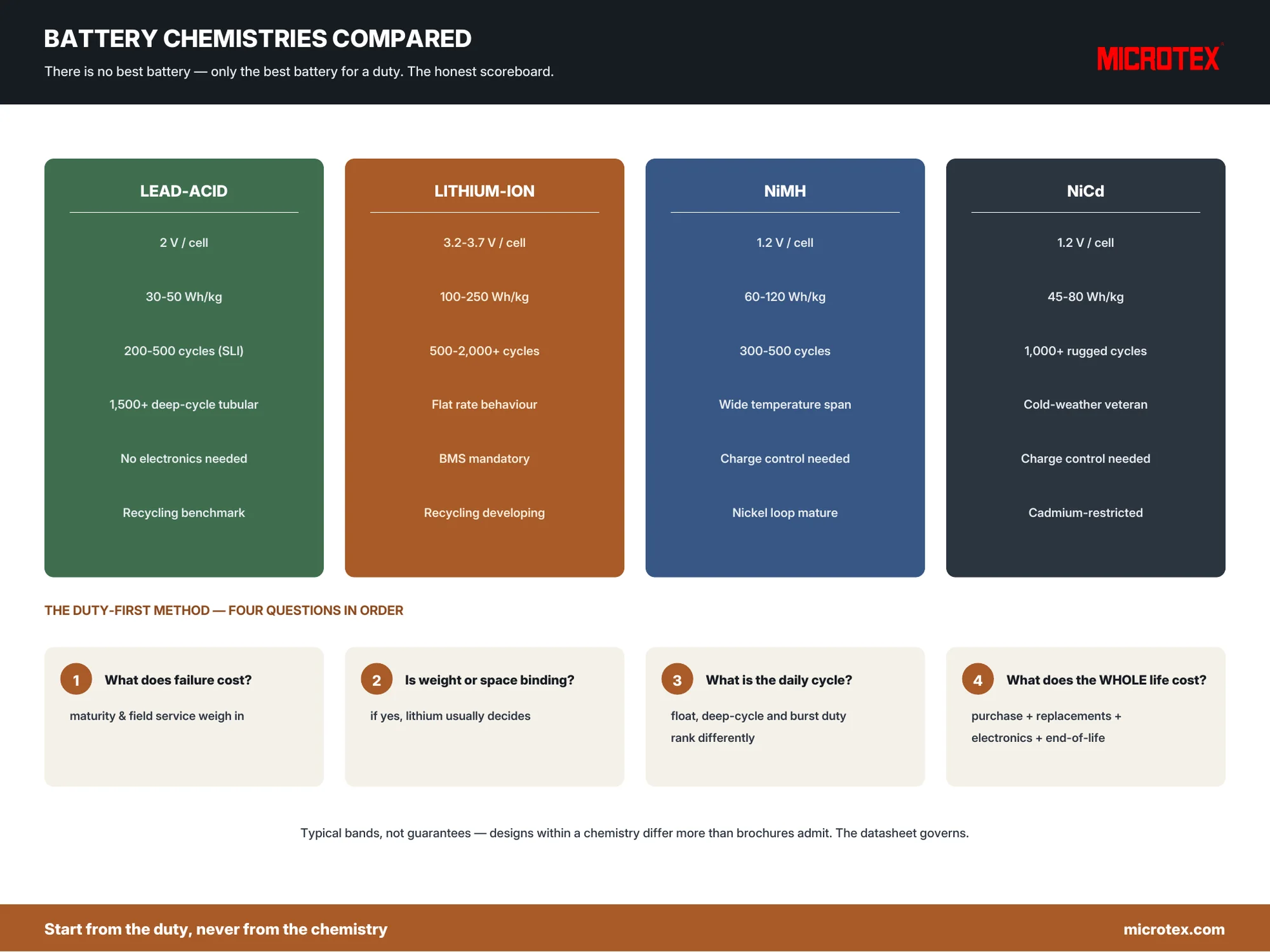
| Parameter | Lead-acid | Lithium-ion | NiMH | NiCd |
|---|---|---|---|---|
| Cell voltage (nominal) | 2 V | 3.2 V (LFP) – ~3.7 V (layered) | 1.2 V | 1.2 V |
| Specific energy, cell level | ~30–50 Wh/kg | ~100–250 Wh/kg by type | ~60–120 Wh/kg | ~45–80 Wh/kg |
| Cycle life (design-dependent) | 200–500 (SLI flat plate); ~1,500+ at 80% DOD (deep-cycle tubular) | ~500–2,000+ by chemistry and duty | ~300–500 typical | ~1,000+ in rugged designs |
| Rate behaviour | Capacity falls as current rises (Peukert) | Far less rate-sensitive | Mildly rate-sensitive | Falls at high rates |
| Cold and heat | Wide tolerance, capacity dips cold | Charging below 0 °C restricted | Wide tolerance | Excellent cold performer |
| Supervision needed | None mandatory | Management system mandatory | Charge control needed | Charge control needed |
| Recycling maturity | Industry benchmark (~99% of lead) | Developing | Established for nickel | Cadmium toxicity restricts use |
The duty-first method
Start from the duty, never from the chemistry. Ask four questions in order. One — what does failure cost? If failure is unacceptable and servicing is manual, maturity and field-diagnosability weigh heavily. Two — is weight or floor space the binding constraint? If yes, lithium’s energy density usually decides. If the battery sits on a concrete floor for years, weight is rent-free. Three — what is the daily cycle? Shallow float duty, deep daily cycling and burst starting duty rank the chemistries in different orders — and within lead-acid alone, the discharge rate changes the effective capacity. Four — what does the WHOLE life cost? Purchase price, replacements, charging losses, supervision electronics, and end-of-life value (lead-acid ends life as scrap value; some chemistries end as a fee). Answer those four and the table above usually leaves one sensible candidate — occasionally two, in which case the cheaper-to-own one wins.
Where each chemistry earns its living
Lead-acid owns duties where cost per kWh, abuse tolerance, serviceability and recycling rule: starting, substation and standby float, forklifts and motive power, budget solar — the full case is in the complete guide and the honest ledger. Lithium-ion owns duties where weight, footprint or deep daily cycling rule — phones to EVs to compact storage; its history, chemistry and honest limits have their own guide. NiMH holds proven niches — hybrid fleets, consumer cells, wide-temperature duty — covered in its article. NiCd, the rugged cold-weather veteran, survives mainly where regulations still permit it — aviation and railway niches — its cadmium toxicity having retired it from general service. The chemistry the brochures promise for tomorrow, the solid-state battery, gets an honest status report of its own.
Terms live in the glossary. And if your duty sits awkwardly between two columns of that table, describe it to us — we sell lead-acid batteries, and we will still tell you honestly when your application isn’t one of ours.