
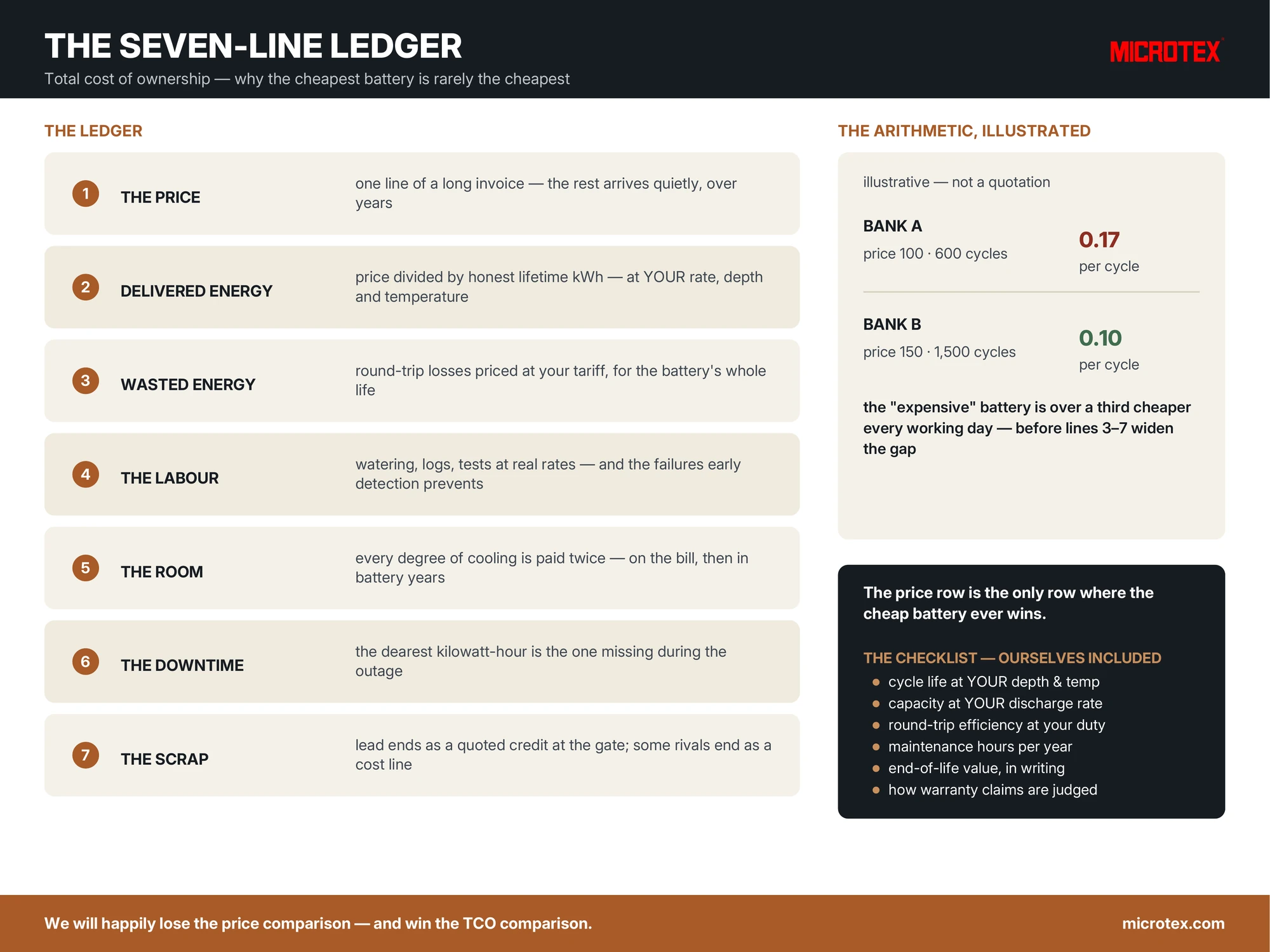
The cheapest battery on the comparison sheet is rarely the cheapest battery you will own. Purchase price is one line of a long invoice. The rest arrives quietly, over years: in the electricity the battery wastes, the hours a technician spends on it, the cooling its room demands, the shift it fails to power, and finally in what the scrap dealer pays — or charges — at the end. Engineers call the honest total the TOTAL COST OF OWNERSHIP, and it is the closing argument of this sixty-guide library because every disciplined purchase we have ever watched succeed ended up here. The ledger has seven lines: the price, the energy actually delivered, the energy wasted, the labour, the room, the downtime, and the scrap. Walk them once and you will never read a quotation the same way again.
Line two: cost per delivered kilowatt-hour
A battery is not a thing you buy; it is a stream of kilowatt-hours you buy in advance. The size of that stream is cycle life at YOUR depth of discharge multiplied by usable capacity at YOUR discharge rate — and neither number is the one in bold type on the brochure. Capacity shrinks as you draw faster, which is Peukert’s law; the nameplate figure is true only at the gentle laboratory rate printed beside it, which is what the C-rate small print means; and the stream ends the day one of the known killers ends it, which is how batteries actually die. Divide each quoted price by each battery’s honest lifetime kilowatt-hours — at your rate, your depth, your temperature — and watch the ranking on the comparison sheet rearrange itself. This one division is most of TCO.
Line three: the electricity you buy and throw away
No battery returns every kilowatt-hour it is fed; the difference leaves as heat, and you paid full tariff for all of it. Over years of daily cycling that quiet loss becomes a serious sum — and here honesty cuts against us: lead-acid’s round-trip efficiency is lower than lithium-ion’s, so in hard daily-cycling duty the efficiency line genuinely favours the dearer chemistry. In float and standby duty, where the battery mostly waits, the same line barely registers. The discipline is identical either way: ask every vendor for round-trip efficiency at YOUR duty, and price the losses at your tariff across the battery’s whole life — because you will be buying them.
Lines four and five: the labour and the room
A flooded bank asks for watering, log-keeping and a periodic test regime; a sealed bank asks for far fewer hours but surrenders the visibility that lets a technician catch trouble early. Both facts belong in the ledger, priced at your real labour rates — hours are money, and so are the failures that early detection prevents. Then the room. Heat is the great ager of batteries — Arrhenius’ theory is the arithmetic — so every degree of cooling is paid for twice: once on the electricity bill, and once again in lost battery years if you decline to pay it. A chemistry that tolerates your climate without air-conditioning can win the ledger while losing the price row; the battery-room guide sets out the four duties the room owes its battery.
Line six: the kilowatt-hour that was not there
The most expensive kilowatt-hour in industry is the one that was missing during the outage: the forklift shift not worked, the switchgear room gone dark, the process interrupted mid-batch. Downtime routinely costs more per hour than the price difference between two competing batteries costs in total — which is why reliability is a ledger line, not a virtue. Our failure-analysis post-mortems keep returning the same verdict: most premature battery deaths were preventable — banks bought too small, cooked in hot rooms, chronically undercharged. The discipline that prevents them is not sentiment about maintenance; it is money, recovered.
Line seven: the scrap credit
Lead-acid ends its life as a raw material. The recycling loop is so complete that a retired bank has real, quoted value at the scrap gate on replacement day — a rebate you can write into the TCO before commissioning, because it is as certain as the battery’s eventual death. Some rival chemistries are still building their loops, and for them end-of-life today can be a cost line rather than a credit. An honest vendor will tell you which applies; ask for the arrangement, and its value, in writing. It belongs in the ledger with everything else.
The arithmetic, illustrated — and the buyer’s checklist
Illustrative arithmetic, not a quotation — these numbers are invented to show the method. Say Bank A is priced at 100 (in any currency you like) and honestly delivers 600 cycles at your depth of discharge; Bank B is priced at 150 and honestly delivers 1,500 cycles at the same depth with the same usable energy per cycle. Bank A costs 0.17 per cycle; Bank B costs 0.10 — the “expensive” battery is over a third cheaper every working day, before the efficiency, labour, room, downtime and scrap lines have even been added, and each of those usually widens the gap in the same direction. That is the whole trick of TCO: the price row is the only row where the cheap battery ever wins. So carry a checklist to every vendor, ourselves included: cycle life at YOUR depth of discharge and temperature, not the brochure’s; capacity at YOUR discharge rate; round-trip efficiency at your duty; watering and maintenance hours per year; the end-of-life arrangement and its value in writing; and how a warranty claim is actually judged — the warranty folklore is in our myths post, with verdicts. And the house position, stated plainly at the end of this library as it was at the beginning: we will happily lose the price comparison and win the TCO comparison. Ask us to show you both, side by side — with the working shown.