
A forklift battery’s life is decided in the charging bay, not in the aisle. The truck is bought with care, the battery is sized with care, and then the charger is ordered as an afterthought — whatever came with the last truck. Crompton’s reference book puts the rule in one sentence: the correct size of charger “will be determined by the number of cells, the ampere hour capacity and the time available for recharge”. Three numbers. Get one wrong and the fleet spends years paying for a machine that cost a fraction of the battery it is slowly ruining. This guide is the sizing conversation we have with every fleet buyer, written down — what the three numbers mean, what a good charger does with them, how the shift pattern decides how many batteries you really need, and where opportunity charging helps and where it quietly costs you.
The three numbers
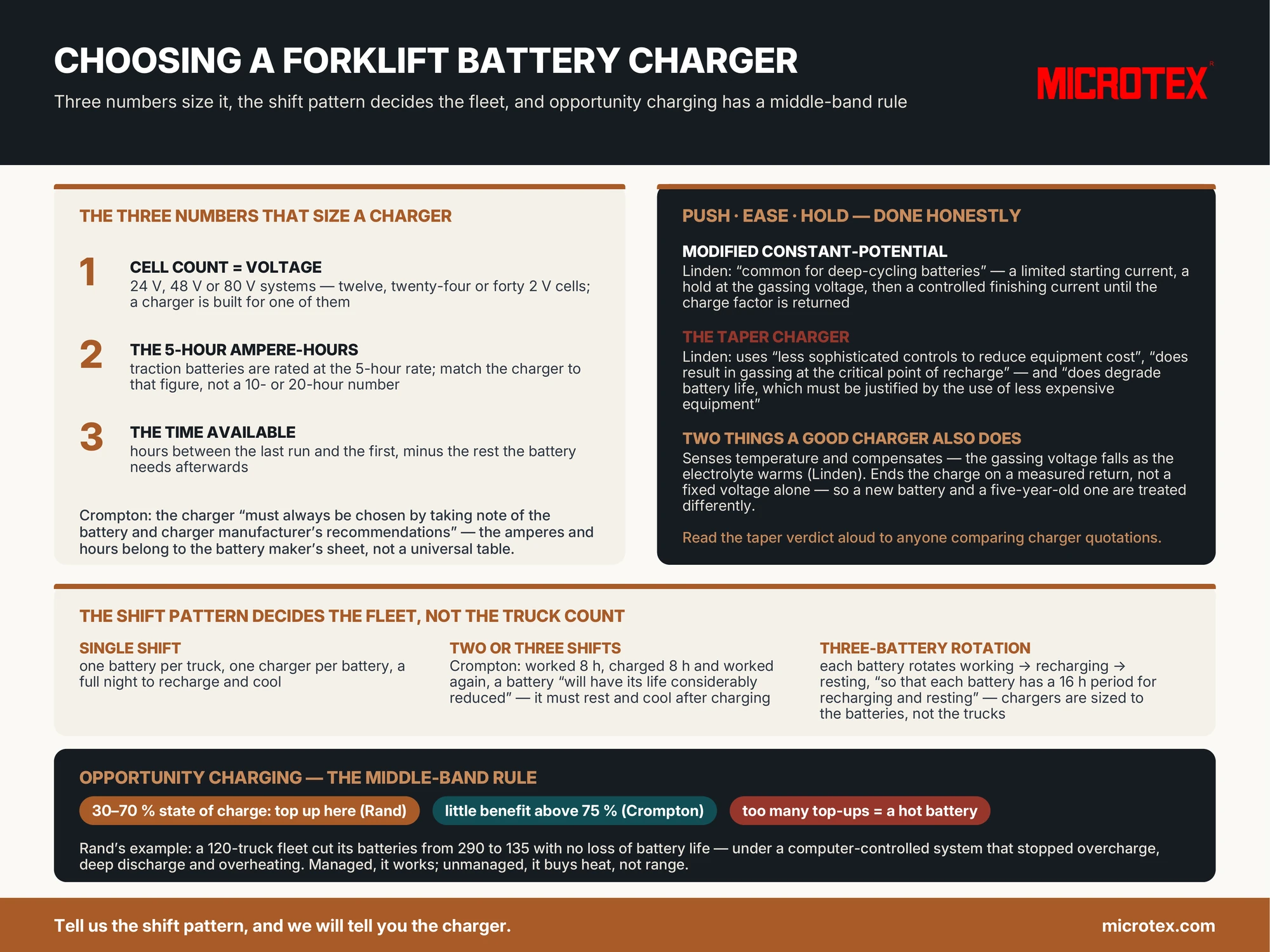
The first number is the cell count, which is the same thing as the battery voltage. Warehouse trucks run on 24 V, 48 V or 80 V systems — twelve, twenty-four or forty 2 V cells in a steel tray — and a charger is built for one of them. A 48 V charger on a 24 V pallet-truck pack is not “too strong”; it is the wrong machine, and a good one will refuse to start. The second number is the ampere-hour capacity, and here the trap is the rating condition: traction batteries are rated at the 5-hour rate, and the charger must be matched to that figure, not to a 10-hour or 20-hour number lifted from a different datasheet — our guide to reading a battery datasheet explains why the same battery carries several capacities. Match the charger to a bigger battery than you have and it pushes too hard; match it to a smaller one and the battery never fills. The third number is the time available — the hours between the truck’s last run and its first, minus the rest the battery needs afterwards. Crompton’s rule is that the charger “must always be chosen by taking note of the battery and charger manufacturer’s recommendations”: the amperes and the hours belong to the battery maker’s sheet for that battery, not to a universal table. A charger which promises to refill any battery in any time is promising to gas one of them.
What a good traction charger does with them
Every traction charger has to do the same three things — push hard while the battery is empty, ease off as it approaches the gassing point, and finish gently — the push-ease-hold shape our guide to battery chargers describes. What separates chargers is how honestly they do it. Linden’s handbook describes the modified constant-potential method as “common for deep-cycling batteries”: a limited starting current, a hold at the gassing voltage, then a controlled finishing current until the charge factor is returned — the extra tenth or so that our guide to charge factor and efficiency explains you always put back. The cheaper alternative is the taper charger, which Linden says uses “less sophisticated controls to reduce equipment cost” and “does result in gassing at the critical point of recharge, and the cell temperature is increased”; his verdict is that “the taper charge does degrade battery life, which must be justified by the use of less expensive equipment”. Read that sentence aloud to anyone comparing charger quotations. Two further things matter. The gassing voltage moves with temperature — Linden’s tables show it falling as the electrolyte warms — so a charger that senses temperature and compensates protects a battery in a hot Indian bay as a fixed-voltage machine cannot, the same physics our guide to charging in cold weather describes from the other end of the thermometer. And a charger that ends the charge on a measured return rather than on a fixed voltage alone treats a new battery and a five-year-old one differently, which is what they need.
The shift pattern decides the fleet, not the truck count
A single-shift operation is the easy case: one battery per truck, one charger per battery, a full night to recharge and cool. The trouble starts with the second shift. Crompton is blunt: “A battery that is continuously worked for 8 h, charged for the next 8 h and immediately worked again will have its life considerably reduced. Batteries must be given a rest between charging and being discharged again, during which they can cool down.” A battery is warm when the charge ends — the finishing stage is the least efficient and most heat-producing part of the cycle — and sending it straight back to the aisle means it works hot, and a hot battery ages at the doubled rate our Arrhenius guide describes. His answer for round-the-clock work is three-battery operation: each battery rotates between working, recharging and resting, “so that each battery has a 16 h period for recharging and resting”. That is the arithmetic behind the swap room our guide to battery swapping describes, and it changes the charger count too: chargers are sized to the batteries, not the trucks. If you cannot give the battery its rest, the honest fix is a spare battery, not a hotter charger.
Opportunity charging: the benefit and the tax
Opportunity charging, in Rand’s definition, “simply involves plugging into the charger whenever there is an opportunity, e.g. between shifts, when waiting for work, during rest or meal breaks”. The benefits he lists are real — no second battery for a two-shift operation, no battery changes between shifts, a smaller battery for single-shift work — and his best example is an operator of 120 electric trucks whose battery count fell “from 290 to 135” after switching to it, with “no observed decrease in average battery life”. Read the next sentence too: that result was achieved “through the use of a computer-controlled battery management system which ensured that the batteries were not overcharged, or discharged too deeply, and also warned when overheating was taking place”. The practice works when it is managed and hurts when it is not. Two rules from the shelf keep it on the right side. Rand: opportunity charging “works best when batteries are in a 30 to 70% state-of-charge” — top up in the middle band, never chase the top, because as our charge factor guide explains, the last portion of a charge is the expensive, gassing, heating portion, which is why opportunity charging feels efficient and is not. Crompton: “there is little benefit in charging the battery when it is 75% charged or above”, and “too many opportunity-charging periods during a working shift may cause unacceptably high battery temperatures”. A fleet that opportunity-charges from three-quarters full at every tea break is buying heat, not range. A fleet that plugs in at half-charge over the lunch hour, with a charger that knows when to stop, is doing what the airport tugs in Rand’s example did — and still giving the battery its full charge and its weekly equalising charge overnight.
Reach trucks, stackers and pallet trucks
The three numbers do not change for the smaller machines; the mistakes do. Reach trucks, stackers and powered pallet trucks mostly run 24 V packs, often built from monobloc semi-traction batteries rather than 2 V cells — our guide to semi-traction batteries explains what that trade word does and does not promise. The common failures we see are a charger bought for the voltage only, so that a small pack is charged on a machine sized for a counterbalance truck; a fleet of mixed pack sizes sharing one “universal” charger; and on-board chargers on pallet trucks plugged in at every pause and left to chase the top of charge all day. The same discipline applies: match cells and ampere-hours, give the battery its rest, opportunity-charge in the middle band, and let the maker’s sheet — not the charger’s marketing — say what the current should be. The room matters as much for a stacker as for a forklift: charging makes hydrogen at the end of every charge, as our guide to battery-room hydrogen sets out, and a charger tucked behind the racking is the usual way a small fleet learns that.
What to send us
We size and supply traction batteries and would rather see them charged properly than replaced early, so the sizing conversation is free. Send us six things: the truck models and their battery voltage; the battery’s 5-hour ampere-hour rating (or the compartment size if the battery is not yet chosen); the shift pattern, honestly, including overtime; the hours the truck genuinely stands still, and when; the summer temperature of the charging bay; and whether you will run a swap room or want one battery per truck. From those we will tell you how many batteries the operation really needs, what each charger must do, and whether opportunity charging will help you or tax you. Tell us the shift pattern, and we will tell you the charger.
Sources quoted: T. B. Reddy (ed.), Linden’s Handbook of Batteries, 4th ed. (McGraw-Hill, 2011); R. M. Dell and D. A. J. Rand, Understanding Batteries (Royal Society of Chemistry, 2001); T. R. Crompton, Battery Reference Book, 3rd ed. (Newnes, 2000).