
A lead-acid battery quotation carries a validity date because the London Metal Exchange carries a clock. Buyers notice it every time: the same battery, the same factory, a different price a month later, and a line at the bottom saying the offer is good for fourteen days. Nothing in the battery changed. The metal did. Lead is not an ingredient of a lead-acid battery in the way copper is an ingredient of a motor; it is most of the battery — the grids, the tubular spines, the active material in every plate, the straps, the posts — and its price is set daily on a public exchange that neither the maker nor the buyer controls. This guide explains how much of the battery is lead, what the lead market looked like as of September 2026, why a quote still moves when lead does not, and what a buyer should ask so that two quotations can be compared on the same day’s metal.
How much of the battery is lead
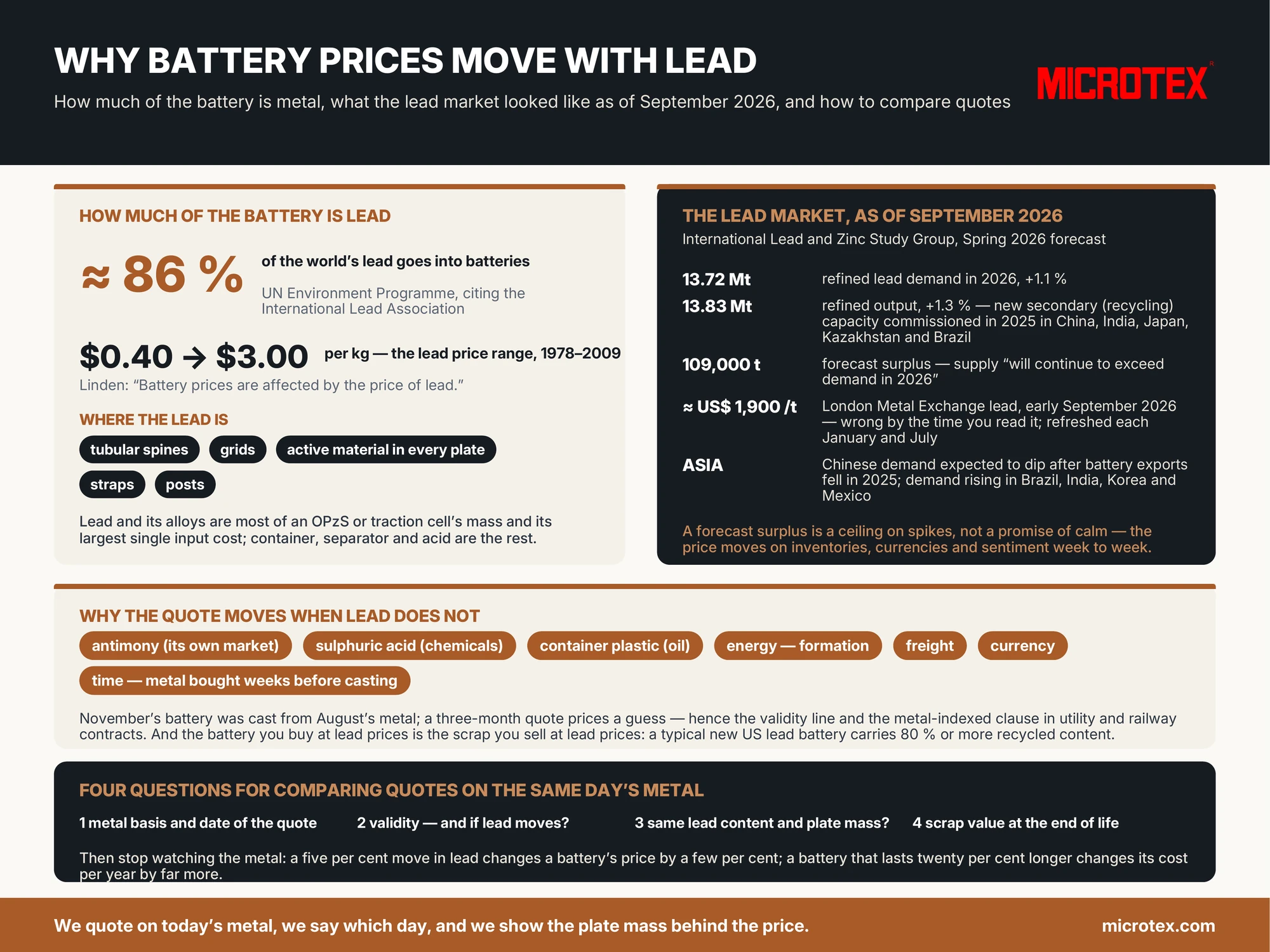
Ask it the other way round first: how much of the world’s lead is battery? The United Nations Environment Programme, citing the International Lead Association, puts it at “approximately 86 per cent of the total global consumption of lead” — the metal’s market is, to a first approximation, the battery market. Inside an industrial cell the relationship is just as lopsided. A tubular positive plate is a cast lead-alloy spine inside a tube of lead-oxide paste; the negative is a lead-alloy grid carrying lead paste; the cell straps and terminal posts are lead; the container, the separator and the acid are the rest. Lead and its alloys are the majority of the mass of an OPzS or traction cell and by far the largest single input in its cost — which is why our guide to the antimony squeeze had to be written about a metal that makes up only a few percent of the spine alloy, and why this one is about the metal that makes up the rest. Linden’s handbook makes the point in a footnote to its market tables: “Battery prices are affected by the price of lead. Lead prices varied from $0.40 to over $3.00/kg between 1978 and 2009.” A more-than-sevenfold swing across three decades, for a product whose customers expect a stable price list.
The lead market, as of September 2026
The reference body is the International Lead and Zinc Study Group, an intergovernmental organisation that meets twice a year and publishes its forecasts. Its Spring 2026 release, from Lisbon in April, expects global demand for refined lead to rise by 1.1 percent this year to 13.72 million tonnes, and refined output to rise by 1.3 percent to 13.83 million tonnes — “mainly influenced by rises in China, India, Japan, Kazakhstan and Brazil, where new secondary capacity was commissioned in 2025”. Secondary means recycled: the new smelting capacity coming on stream is recycling capacity, the loop our guide to battery recycling describes. The result, in the Group’s words, is a market where supply “will continue to exceed demand in 2026, with the amount of the surplus increasing to 109,000 tonnes”. Two regional notes matter to anyone buying in Asia: the Group expects Chinese lead demand to fall slightly this year, after “net exports of lead-acid batteries declined” in 2025, while demand is “expected to rise in Brazil, India, the Republic of Korea and Mexico”. On the price itself, market-data services quoting the London Metal Exchange put lead at roughly 1,900 US dollars a tonne in early September 2026 — a figure that will be wrong by the time most readers reach this sentence, which is the point of the paragraph, and why we will refresh it each January and July. A forecast surplus is a ceiling on spikes, not a promise of calm: the exchange price moves on inventories, currencies and sentiment week to week, and the battery quote moves with it.
Why the quote moves when lead does not
Lead is the biggest lever, not the only one. The spine alloy carries antimony, whose price went its own way — that story has its own guide. The electrolyte is sulphuric acid, priced with the chemical industry, not the metal one. The container and lid are engineering plastic, priced with oil. Casting, pasting, curing and formation consume energy — formation especially, the long first charge our guide to battery formation describes — and energy is priced by the power tariff. Freight is priced by the shipping market, and an export quote is priced in a currency: for an Indian factory buying metal in dollars and selling in rupees or dollars, the exchange rate moves the number even on a day the exchange price is flat. Then there is time. A battery maker buys its lead weeks before the cells are cast, casts them weeks before they are formed, and ships them weeks after that; the metal in a battery delivered in November was bought at an August price. A maker who quotes today for delivery in three months is guessing the metal, and prices the guess — which is why the validity line exists, and why some industrial supply contracts replace the guess with a metal-indexed price adjustment clause: the battery price moves up or down with a published exchange average, so that neither side is betting against the other. Whether that clause is worth having depends on the size of the order and the length of the contract; it is common in utility and railway supply and rare in a one-off purchase.
The other side of the same price
What makes lead unusual among battery materials is that the price cuts both ways for the same buyer. The battery you pay lead prices for today is the scrap you sell at lead prices in ten or fifteen years — our guide to the closed loop explains why end-of-life value in this chemistry carries a positive sign, and the Study Group’s note that 2026’s supply growth comes from new secondary capacity is the same fact seen from the smelter’s side. In the United States, where the collection rate is measured, the industry’s own study reports that the typical new lead battery already contains 80 percent or more recycled content. A higher lead price makes your new battery dearer and your old one worth more; it also makes informal, unsafe recycling more tempting in countries without collection discipline, the honesty our recycling guide insists on. A buyer who tracks the metal should track it at both ends of the battery’s life.
What to ask when comparing quotes
Four questions turn a page of prices into a comparison. Ask each supplier for the metal basis of the quote — the exchange price and date it assumes — so that a cheaper offer written on a cheaper week is seen for what it is. Ask how long the price is valid and what happens if the metal moves before the order is placed. Ask whether the quoted battery has the same lead content as the one it is being compared with: two cells of the same nominal ampere-hours can differ substantially in plate mass, and the lighter one is cheaper for a reason our guide to flat plate versus tubular explains — the thinner plate is not a bargain, it is a shorter life. And ask what the battery will be worth as scrap, because a quote that ignores the credit at the end overstates the cost of the heavier, longer-lived cell. Then stop watching the metal. A five percent move in lead changes a battery’s price by a few percent; a battery that lasts twenty percent longer changes its cost per year by far more, which is the whole argument of our guide to battery total cost of ownership. And if the question behind the question is whether lead-acid’s price advantage over lithium survives, our ten-year outlook answers it with sourced numbers, twice a year. We quote on today’s metal, we say which day, and we will show you the plate mass behind the price — ask us for the basis, and compare us on it.
Sources quoted: T. B. Reddy (ed.), Linden’s Handbook of Batteries, 4th ed. (McGraw-Hill, 2011); International Lead and Zinc Study Group, Spring 2026 session forecasts, press release (Lisbon, April 2026); United Nations Environment Programme (citing the International Lead Association), on lead consumption by use.