
The lead-acid battery is more than a hundred and sixty years old, and it has just learned a genuinely new trick. Not a marketing trick — a materials one: put the right carbon in the negative plate, and the chemistry’s oldest weakness starts to give way. The result is called the lead-carbon battery, and it is the most interesting thing to happen inside our own family of chemistries in a generation. This is its story told the house way: what it fixes, how, where it came from — the lineage runs through one of the world’s great research organisations — where it stands commercially, and the limits its own enthusiasts sometimes forget to mention.
The weakness it fixes
Classic lead-acid has one duty it truly hates: cycling without regular full recharge — life at PARTIAL STATE OF CHARGE, the regime the trade calls PSOC. It is the daily reality of solar service, of renewables smoothing, of any hybrid duty where the battery works constantly and is seldom given the long, finishing charge it wants. Under PSOC the damage concentrates on the NEGATIVE plate: discharge product lingers, and lead sulphate crystals coarsen into the hard, inert form that charging can no longer reconvert — sulfation, the preventable death, made steadily less preventable by the duty cycle itself. The classical remedies — prompt full charges, periodic equalising — assume the duty pauses long enough to apply them. Modern storage duty does not pause. So the question that produced the lead-carbon battery was precise: can the negative plate be taught to survive the regime, rather than asking the regime to be kind?
What the carbon actually does
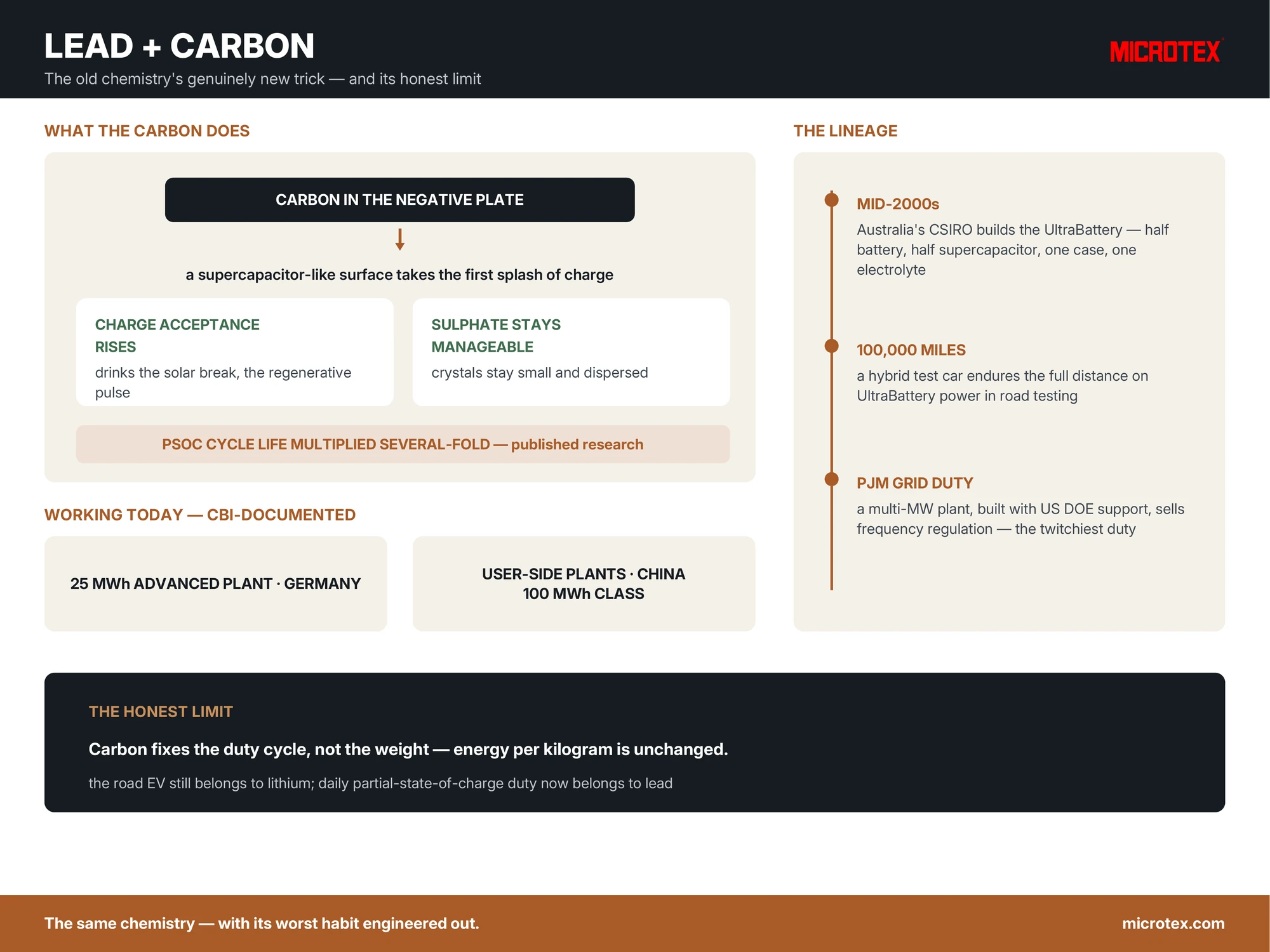
The answer, per the published research, is yes — with carbon. Blend suitable carbons into the negative active material (or pair the lead plate with a carbon electrode outright) and the plate acquires a second personality: alongside the battery reaction runs a supercapacitor-like surface that soaks up sudden charge the way a sponge takes the first splash, evening out current distribution across the plate. Two consequences follow. Charge ACCEPTANCE rises — the battery drinks fast, opportunistic charge (a solar break in the clouds, a regenerative pulse) that a conventional negative would partly refuse. And the sulphate stays MANAGEABLE: with current spread evenly and the plate’s surface kept electrochemically busy, crystals stay small and dispersed instead of coarsening into the fatal film. The research literature — much of it published through the lead industry’s research consortium — documents PSOC cycle life multiplied several-fold over conventional designs. The battery does not become a different chemistry; it becomes the same chemistry with its worst habit engineered out.
The lineage: CSIRO’s UltraBattery
Lead-carbon’s most famous ancestor has a name and a birthplace worth citing properly. In the mid-2000s, researchers at Australia’s CSIRO — the Commonwealth Scientific and Industrial Research Organisation — built the UltraBattery: half lead-acid battery, half supercapacitor, sharing one case and one electrolyte, so the capacitor half catches the violent charge-discharge spikes while the battery half does the steady work. The invention was licensed to American and Japanese manufacturers and then did something rare for a laboratory darling: it proved itself in public. A hybrid test car ran a hundred thousand miles on UltraBattery power in road testing — the endurance run our electric-vehicles guide recounts — and in the United States a multi-megawatt UltraBattery plant, built with Department of Energy support, sold frequency-regulation service into the PJM grid market, holding its own in the twitchiest duty a grid can offer. The lesson of the lineage is the lesson of this whole post: lead plus carbon is not a slogan; it is tested engineering with a paper trail.
Where lead-carbon stands commercially
As of 2026 lead-carbon is a real, if modest, presence in stationary storage. The Consortium for Battery Innovation — successor to the Advanced Lead-Acid Battery Consortium that shepherded much of this science — documents working installations from a 25 megawatt-hour advanced lead-carbon plant in Germany to user-side storage plants in China at the hundred-megawatt-hour scale, and its current technical roadmap sets cycle-life and charge-acceptance targets aimed squarely at storage duty. Nobody should overclaim the position: lithium iron phosphate dominates new grid storage, as our BESS guide reports plainly. But lead-carbon gives the lead industry a credible entry in precisely the niches where lead’s other virtues — the closed recycling loop, heat tolerance, price, and a supply chain with no geopolitics — already argue its case: solar and hybrid systems, cycling microgrids, and storage where budgets are real and cooling is a luxury.
The honest limits
Now the paragraph its enthusiasts skip, which this site never will. Carbon fixes the DUTY-CYCLE weakness, not the weight: a lead-carbon battery stores essentially the same energy per kilogram as its conventional sibling, because the energy still lives in the same lead and acid. It will not make a road EV — that road belongs to lithium, as we have said in print — and it does not repeal the need for honest sizing, decent chargers or shade. What it does is widen lead-acid’s playable board: duties that once quietly killed lead batteries — daily PSOC cycling under an unreliable sun — become duties lead can hold, at lead prices, inside lead’s recycling circle. In a decade that will argue endlessly about chemistry, that is the future-facing version of our old trade: not younger, just better-armed. If your project lives in the PSOC zone — solar, hybrid, cycling storage — talk to us and we will tell you honestly which battery construction survives your duty cycle, and why.